Sunday, August 16, 2015

Women In The Shadows


I posted a while ago about how I have become hooked on family history.  I continue to make discoveries both great and small: finding  an envelope in an old box of photographs containing three pages of reminiscences written in a shaky hand by my grandmother recalling her early life in Newtown, tracking down through birth announcements, school records and newspaper stories that my second cousin once removed was a champion footballer who won three ‘best and fairest’ player medals and had a Prussian  army captain for a grandfather, learning that one of my great grand aunts became the  single mother of two young girls quite unceremoniously when her husband was arrested for producing and passing forged £1.00 notes and deported to Noumea.


It seems possible that my paternal line is traceable back to Switzerland in 1200 AD, but investigating that is just too mind boggling given that I am challenged enough fleshing out the past four generations in Australia! With the help of a first and a second cousin and various databases, I have been able to piece together quite a lot of my family members’ lives and stories.  Now that I have ‘gone bush’ I can’t easily visit the record repositories, museums and cemeteries that are the haunt of ‘genies’ but it is amazing how much is available online and it is heart-warming how generous other family history buffs  and volunteers at local historical societies can be.  I am as excited now at the arrival of a package of photocopies of documents and pictures as I used to be at the arrival of bric-a-brac I had bought on eBay!

But I have to remark on one complication that hampers my research.  I kept my so-called maiden name i.e. the surname I was born with, both for ideological and practical reasons, when I married back in the 80s.  I had not been bitten by the genealogy bug back then and it never occurred to me that continuity of identity had implications beyond feminist principles and avoiding the mess of changing bank accounts, electoral roll listings etc.  It wasn’t until I saw Armandine Garnay disappear to be replaced by Mrs R. L. Thornber and Regina Louise Pittard morph first into Mrs Charles Norett, re-emerge temporarily as Mrs Regina Norett (widow), only to be subsumed by the moniker Mrs J. B. Wallis (one of three succeeding women to be known by that name) and then to surface briefly as Mrs R.L. Wallis (widow) in the last few years of her life, that I realised how difficult the custom of assuming one’s husband’s name makes family research.  Add to this non-standardised spelling, 'Noirette' for 'Norett' and 'Wallace' for 'Wallis', and it can take a lot of detective work and guesswork to track down female relatives.

Another challenge is what the papers considered newsworthy in past eras. Business ventures and sporting achievements often got a mention so I stumbled upon (male) entrepreneurs, cricketers and footballers in the family quite quickly.  Female golfers and bowls players occasionally made it into the papers’ columns but a single initial and surname are hard to verify as the particular ancestor you’re seeking.  Marriages, births and deaths, assuming the family had the price and presence of mind to post a notice, can be depended upon to an extent. The first two usually reveal the bride’s/mother’s former identity. I remember the first time I heard the term ‘nee’ referring to a woman’s surname prior to marriage. It was on the saucy sit com ‘George and Mildred’ when Mildred was referred to as Mildred Roper (nee Trembler). Boom tish!  Incidentally, the Newcastle region leads the pack in their enthusiasm for printing wedding photographs, their local papers, in my experience,  had by far the richest source of blurry black and white pictures of newly hitched couples back in the 1940s and 50s.

Unless they moved in exalted social circles (none of my forebears really did) or were conspicuously active in the Country Women’s Association (Armandine Thornber nee Garnay was forever demonstrating her spinning or judging at rural shows) not many women featured in the newspapers. Of course women who held  important positions as matrons or headmistresses got some coverage, but shopkeepers, seamstresses, laundresses and those discharging ‘home duties’ (the term the census  used)  like my lot, only featured in the paper if they took out a classified ad selling a pony or a sewing machine.  Nowadays the likes of the Trading Post online and Gumtree and the explosion of social media have made both ‘For Sale’ notices and wedding coverage in newspapers redundant, but they helped to bulk up copy until about the 1980s.

My great grandmother was selling a pony and sulky in 1912.


So large chunks of women’s lives were not revealed in the media and, to my frustration, my female antecedents go ‘off the radar’ for years at a time especially if they weren’t reproducing during that period. Like the veiled mothers in Victorian photographs you may sense their outlines behind their more prominent offspring. Later their attire at their progenies' weddings might attract a few words in a newspaper but not for them election as aldermen, retirement send offs or visits to court to recoup debts or declare bankruptcy.  Even the ratio of industrial accidents and driving offences is firmly weighted along gender lines. While male relatives have had trees fall on them at work, lost fingers on the production line, been pulled over for faulty headlights or charged with indecent language, I have only been able to trace one female in our tree being fined for driving under the influence and she is only a relative by marriage!


A Victorian 'hidden mother' photograph  - she's there to keep the children from wriggling  but why disguise her?


Thank goodness for Trove (the National Library’s collection database) I have discovered so much trawling through it.  Some of my ancestors got more than their 15 minutes of fame – if they served their country, opened a successful emporium or played a pretty classy game of football – but the women got disproportionate obscurity, some not even accorded their own ‘real’ names in their death notices.   My greatest satisfaction and ongoing quest is to talk to those family members still around today who can throw a light on the shadows they inhabit.

Monday, April 6, 2015

Eight legs bad?

“And God made the beasts of the earth according to their kinds and the marsupials of the bush according to their kinds, and everything that creeps, slithers and scurries upon the ground according to their kinds, and even the sneaky cats who pounce on anything that creeps, slithers or scurries according to their kinds. Not to mention any number of things that bite, sting, build webby structures to ensnare the unwary or just look really menacing according to their kinds. And God can’t seriously have seen that it was good. At the very least he must have admitted that his creation was a bit fraught with moral dilemmas, I mean, really, was he having a laugh or what?” (Genesis 1: 25 – paraphrased). 

So it’s month seven in the antipodean garden of Eden that is Wagga WaggaNew South Wales! I would like to say that the body count had stabilised at minus two rabbits and one cat but although the latest casualties have not come from amongst the ranks of our pets the carnage goes on.  I have lost count of the variety of dead things, or bits thereof, I have seen.


John Percival's 1951 image of an Australian Garden of Eden (just like Wagga Wagga but without spiders)


Portents were here from the beginning had I but heeded them. There was a cow skull attached to the aviary when we arrived, we've found a wombat skull and several other skeletal remains strewn about in the bushland behind our house. The roads on the journey to Wagga featured plenty of the grey/pink sludge that speaks of ex foxes, rabbits, 'roos and possums.  Death was and  is omnipresent.  


Local skulls 

Notwithstanding the Christian reference I began with, I am now going to go all Hindu and suggest that the demise of any living thing could be viewed as diminishing us all. As a nature lover I have always thought along those lines. However, in later life I am having to harden the hell up! Otherwise I would be in perpetual mourning.

Some deaths come from the indifference of nature like the freak storm one afternoon that brought the temperature plummeting by about twenty degrees and saw off our koi carp, or the strong winds that dislodge the odd nest of fledglings. These deaths I can view as sad but unavoidable.

Many more deaths though are the result of human impact (and here the guilt starts to seep in). The trappings of civilisation we invaders have brought to the bush like the chlorinated pool water that defeated a naive little frog and the swift, convenient vehicles that plough into nocturnal animals. Then there are the expired skinks and small birds that have met their ends courtesy of our supposedly ‘indoor’ rescue cats.

However my own deep, personal shame is that I am now an agent of death -  I regularly commit arachnicide! Is it the thin edge of the wedge? Will it be long before I join the Hunters and Fishers party?

My metropolitan philosophy had ever been to gently evict any creepy crawly that attempted to share our living space, this is how I came to justify a more drastic solution.

For weeks there lurked in the crevices of the rocks around the pool an abundance of spider types. At least a third of them were red backs and although I was assured that their fangs cannot pierce human, canine or feline skin I let my fear and repugnance get the better of me. Soon I was using insecticide, water jets and the base of a thong to despatch them. These weapons (apart from the thongs) knew no nice distinctions and many harmless grass spiders met premature ends in the purge.


Pool (and everywhere else) lounger  

Then there was huntsman season. Something just snapped when my 3 a.m. lunges with upturned Tupperware at the biggest bloody huntsman I've ever seen on the pelmet in my daughter’s room proved completely useless and the monster just scurried about menacingly.  I  protested not one jot when my son tried to ‘take out’ the spider in a more final way than I had planned. He used the plastic wrapped rolled Herald like a kind of javelin/snooker cue hybrid and thrust it at the creature. The spider retreated  between the slats of the blinds and I found one of its legs, though not the rest of it, on the window sill the next day. Within a week its relations were all over the joint and we became quite blasé about removing them with no care for their well-being. Next the humble daddy long legs fell victim to my callousness. So abundant and prolific are they that you can denude a room  of them one day and find five or six in residence again the next.


A simulation of the huntsman on the bedroom wall scenario 
although this one is MUCH smaller!

In fact it is a Waggan thing that spiders and their webs simply abound! The eaves and window frames of every building, the wheels, doors and wing mirrors of every car and the extremities of many plants are festooned with webs that are remade within twenty four hours of being removed. If you have seen the photos taken after the Wagga floods you will know that the local spiders are incredibly resourceful and tenacious. Not for them the watery death facing other fauna, they simply established housing developments atop anything that stuck out above flood level.


The Wagga Wide Web

They say familiarity breeds contempt and just as I hardly gave squishing a cockroach a second thought in Sydney I now view spiders’ invasiveness  - we have found red backs on the stairs, the kitchen counter, the roll-a-door,  sunning themselves amongst my pot plants and lolling poolside as I mentioned before – as justifying my culling. Their prevalence and audacity make me feel vindicated.

So though my heart is still heavy when I think of the deaths of our erstwhile pets or remove the victims of our current ones, and I grieve at the carnage on the roads, I cannot find it in myself to allow Waggan spiders a share in our joint divinity. I consider them expendable, like Sydney cockroaches. Could I be on  on the slippery slope to worse moral relativism?  I hope I am not accruing too much bad karma,  I only squash the red backs though I may have, inadvertently, vacuumed up a couple of other species.


After the deluge, survival of the webbiest.


Oops!

Tuesday, March 3, 2015

Branches everywhere

Given my migrant background, strong sense of nostalgia and lack of living relations  it was probably just a matter of time before I started drawing up the family tree!  It seems to be a middle aged woman thing any way, like wearing a lot of red and purple and going to musical theatre (I’ve got two shows this weekend). I remember once a librarian friend commenting bemusedly about how long the ‘genies’ sat poring over microfiches and Sands directories, thermos and sandwiches in  a carry bag at their side.  I  had to ask her to ‘ploise explain’. Now my own inner genie (genealogist)  is out of the bottle!


An ardent fan of ‘Who Do You Think You Are?’, it didn’t take long for me to interrogate myself similarly. I initially  had  a bit of a go at the tree  two years back when grounded with a broken ankle, but there was nothing like long service leave and a remote location to get the research juices well and truly flowing.  I now have 127 verified rellies on my tree, haven’t paid any subscriptions to the numerous genealogy sites (despite their constant invitations to ‘upgrade’), and have corrected more electronic transcripts of  birth, death and marriage notices on Trove (the National Library’s free archive) than this family has had hot dinners (or at least hot dinners cooked by me – my evenings are precious!)

True to the soap opera nature of family research, I find my focus of interest shifts from dismay and delight at my ancestors’ real estate holdings and business ventures, to ‘ah ha’ moments when the origin of my husband’s and daughter’s  musical talents is revealed, to deep sadness at the number of early, especially childhood, deaths I have discovered.

I am hampered by the common surnames of some of my relatives, you would be bowled over by the numbers of Gladys and Violet Williamses spawned in the UK in the late 19th and early 20th centuries! I am unaccountably enchanted by the sonorous names and made good–ness in the colonies of my husband’s Welsh coal mining antecedents and thrilled when I discover links between their Glebe, Newcastle and West Australian presences!


I know my obsessiveness in uncovering family connections leaves many cold but who hasn’t regretted never asking a now long gone relative to identify the people in an old photograph or to explain why there was  a bit of a cloud around a great aunt’s pregnancy and delivery of those apparently full term twins so early? Memories and family stories are so fleeting – I  am hoping to leave my kids as full a record as time and scanning technology permit.

Sunday, January 18, 2015

Things that look like other things

[Note: please forgive the varying font sizes and formatting issues - have run out of time to try to fix them - will have another go later]

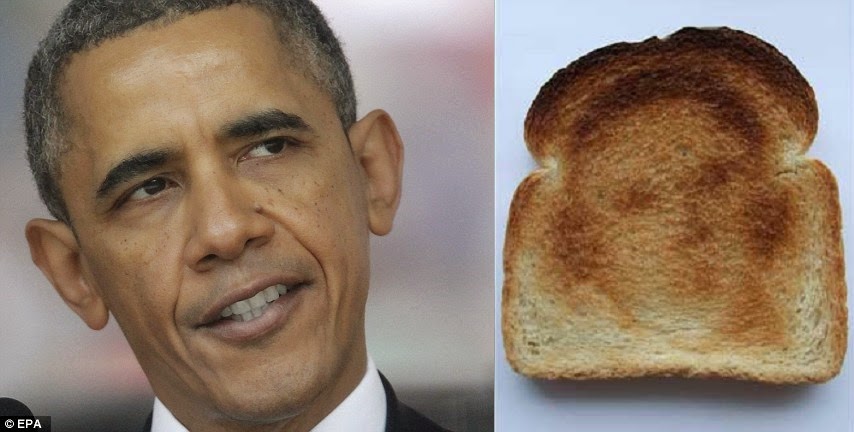
There is a phenomenon known as pareidolia which means perceiving vague or random stimuli (usually images or sounds) as significant. It often takes the form of ‘seeing’ a familiar or meaningful image, such as a human or animal face, in a random pattern or object, Jesus on a slice of toast and animals in cloud formations are examples. Since our brains are programmed to discern faces it isn’t surprising that they feature so prominently in examples of pareidolia.

The drive to see patterns in a field of random  data is apparently  biologically useful as it enables us to pick out food, friend or foe against a background where they would otherwise be camouflaged. It also helps us to learn recognition from our previous encounters with things by creating our own mental stock images files. Unfortunately it also makes us credulous enough to see apparitions in blurry photographs and images of the Madonna in Coogee fence palings, to say nothing of spotting life on Mars!


 'Vision' of the Virgin Mary appearing at Coogee, NSW in 2003


 The so-called Mermaid of Mars

Pareidolia can be a shared experience, like group sightings of ‘ghosts’, or individual like our personal interpretations of Rorschach ink blots. Cultural and individual frames of reference always come into play i.e. your own preoccupations will influence how you ‘read’ the pattern. As one blogger drolly put it, “one person’s Virgin Mary …, is another’s Darth Vader eating a giant sno-cone” (http://skepchick.org/2014/01/bad-chart-thursday-the-pareidolia-plot/)

In the religious pareidolia pantheon Renaissance costume is much preferred -  robes and loincloths abound. Those privileged to see visions of the Virgin Mary and Jesus Christ cannot enlighten us about the actual appearance of the revered ones but can often cite the exact painting the image resembles.  Funny that!


Uncanny likeness - in this instance the Virgin Mary based her rocky manifestation on a romanticised, very anglo 19th century painting. 

Our interpretations of cloud shapes tend to be limited to a stock range of creatures, generally horses, sheep, bears and bunnies, I could not find any pictures of cloud formations resembling Nissan hatchbacks or Nespresso machines but perhaps, unlike the photographers, I wasn’t looking hard enough. Of course picking out shapes in clouds is a great deal easier if said clouds are helped along by the artist’s hand as is the case in the 62nd episode of Disney’s New Adventures of Winnie the Pooh where Christopher Robin and Pooh see a cloud-formed whale, a honey pot, a bee, a pirate ship, and a dragon. I guess it isn’t pareidolia if the image is deliberately drawn that way.

 "Spooky, Tigger, the fluff is out there".

Back in the early 17th century Shakespeare arranged for Hamlet to tease Polonius about the ephemeral and subjective nature of pareidolia in this exchange:

Hamlet: Do you see yonder cloud that's almost in the shape of a camel?
Polonius: By the mass, and 'tis like a camel indeed.
Hamlet: Methinks it's like a weasel.
Polonius: It is backed like a weasel.
Hamlet: Or like a whale.
Polonius: Very like a whale.

Polonius doesn’t want to contradict the wayward prince so makes a complete fool of himself.

Millions were prepared to make a collective fool of themselves in 1968 - 71  when lights appeared in the sky near the Coptic Orthodox Church of Saint Mary in the Egyptian town of Zeitoun  and were perceived as manifestations of the Virgin Mary.  The fuzzy splodges that they attached this significance to are about as like a female form as this McNugget is like George Washington! But hey, no room for Ockham’s Razor when you’re confirming centuries of  superstition. (Good post about it here: http://skepdic.com/zeitoun.html).


 Alarming likeness, it's as if this McNugget was totally channeling old Georgie.

So Jesus himself, his mum and various mammals are traditional pareidoliac sightings but other cultural icons get their share of attention from our pattern insistent brains; Lenin on a shower curtain, Mickey Mouse on the surface of Mercury (what, not Pluto?),  Kate Middleton on a jellybean and, most recently, Barack Obama on that good old standby a slice of toast. 


Some instances of pareidolia are quite personal and specific. As a child I lived in my grandmother’s terrace house and at the spot where the top of the stair banister met the floor of the landing I  clearly saw  a grimacing face  in the cornice. As I was carried up in an adult’s arms I would come very close to this image, which I dubbed ‘the ceiling eye’,  and get frightened.  My father  plastered over the offending vision but like believers in demons everywhere I was convinced it still lurked unseen.


Not 'the Ceiling Eye' but with pareidolia near enough is good enough - always!

Pareidolia has its lighter side. My favourites are functional objects that have cute little faces a la Wall-e. They abound on the net. Here are a couple I really like:


Sometimes, as with Pooh’s clouds, a little artistic licence helps. Here are some I prepared earlier.


So, happy solo or collective hallucinations! Try to expand the popular repertoire. Elvis seems to be the only pop star to have manifested himself - in  a tree and a rock (google him). Where are the Britneys and Bonos? Mother Theresa  appears in a cinamon scroll (definitely google her), but there is no Mary McKillop lamington vision yet recorded. And why should Disney get all the publicity? How about Homer Simpson in your bathroom tiles or  the surface of the moon? Post your discoveries, you may start a cult!

Friday, November 28, 2014

Not Properly Introduced?


Losing our two rabbits and a beloved cat in a single week (to the heat and a brown snake) in our first few weeks in Wagga has led me to reflect on my naivety about the risks our new environment poses and to ponder the strange accidents of history that have put this fairly Anglo family, with its predilection for William Morris arts and crafts and Beatrix Potter-style anthropomorphised pets, in the middle of the Australian bush.

I have been piecing together what Australian history I already knew and what I am learning about the Riverina region specifically to help make sense of my feelings – feelings of loss and displacement side by side with those of exhilaration and rapidly growing love of this landscape and town.

Such sudden evidence of the vulnerability of our urban pets has driven home to me with brutal intensity how paper bark thin is the veneer of suburban decorum here.  Kooringal’s winding streets sport bright green sprinkler-fed lawns,  garden beds of foxgloves and heliotrope and faux classical embellishments adorn the houses, yet many of those houses, like ours,  back onto  rugged, rocky terrain where heatstroke, snakebite and god knows what other perils await. When the sun is relentless and the air is humming I can’t avoid visions of Miranda and her school friends vanishing!

Disappearing into the impenetrable mysteries of the bush, Picnic At Hanging Rock.

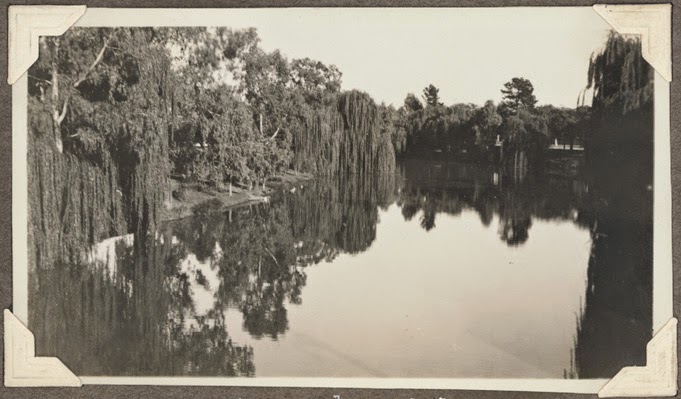
I found an unattributed poem* published in the Wagga Wagga  Daily Advertiser of 25th November, 1941 (65 years  to the day that I am writing this). It expresses the solace provided by quiet reflection on the banks of Wollundry Lagoon, on how the things of Nature, God's kind forgiving smile’ help to heal both the soldier’s mind still full of the ‘frenzy of Tobruk’ and the troubled soul of  ‘some forlorn, weak sister’ who has morally transgressed. Then the poet suddenly conjures up images from the distant past:

(When) in Wollundry's garden a vision strange appears
Of native children playing among the ancient trees,
And camp smoke slowly rising upon the languid breeze.
No trim lawns then and willows, or fragrant scent of rose;
Long reeds and waving grasses, and calling of the crows.
Here dark-skinned men and women; God's creatures yet untamed
Lived innocently happy, untutored and unashamed.
They heard the kookaburra with cheery laughter greet
The sunglow, overspreading the morning, dewy sweet.
They saw the wild duck leaving their night-enchanted haunts
And took what Nature offered to satisfy their wants.
The kangaroos leaped lightly, the emu loitered near
Sufficient for the hunting, the boomerang and spear.
The native life was simple. Its savagery was mild.
And heart, however cultured, still leaneth to the wild.
There is something very pleasing in unspoilt forest still.
Ere man with axe and fire has worked his ruthless will
There heaven-assisted Nature moulds in unrivalled way
Her monumental splendour from elemental clay.

Despite its romantic paternalism (and inaccuracy about who first used fire to manage the land), the poet is attempting some 100 years after Wagga’s genesis as a European town, to grapple with the same paradoxes I am.  To reconcile what consoles her of contemporary values and taste with an imagined past she admires  as elemental, innocent and unspoilt.  She quickly excuses herself from judgement with the line “And who shall say the old thing was better than the new?”


The willows of Wollundry Lagoon in the 1930s (NSW State Records)

But we all do, constantly, declare an old thing better than a new or a new thing better than an old. When land was cleared for grazing in the early-mid 19thC the practice was supported by progressive,  benevolent natural scientist and  pioneer authority on Aboriginal culture, Alfred William Howitt, as ridding the land of miasma producing toxins. Also, as Wagga poet and memoirist, Mary Gilmore relates, sheep and cattle station owners saw the plants and birds which had flourished in  sanctuaries preserved by the local Wiradjuri  people for centuries on the Murrumbidgee as hazards and impositions. They eradicated the river oaks completely and drove the black swans from their nests smashing their eggs. They believed they were cleansing the landscape to better provide for their families, they had no inkling of the salinity that was to affect the soil so soon afterwards.  Regeneration of bush and wetlands decades later shows the old reasserting itself against the new!

We didn’t see  the brown snake get our cat. My son had seen it  earlier in the day winding away from the fishpond, and I had not thought anything of it when he told me. Her symptoms however, back legs giving way with ascending paralysis, venom affecting her breathing muscles and her mouth frothing up, were textbook. I realised that when I did some reading later. We don’t know for sure that the rabbits succumbed to heat exhaustion. They may have dehydrated, rabbits in the city don’t need drinking water you just dampen their veggies. As with the death of any loved one my mind raced with questions about what I could have done to keep my pets from harm.


Backyard grave for two of our perished pets - memorial mound of local rock.

As classes,  cats and rabbits are rightly considered destructive introduced  pests in Australia yet this particular cat and these particular rabbits did no damage, they just proved fragile in the face of the perennial dangers of the bush. Should we have introduced them at all? Done so differently? Or, like our sprinkler-addicted neighbours, should we defy the environment because we enjoy the company of our effete European pets?


These questions can’t be answered. All human society is rife with contradiction and compromise. This land is the brown snake’s home and it is also home to Maltese terriers, McDonalds drive thru,  alyssum borders, fancy garden statuary from Bunning’s and now also home to our 'rescue' new cats. We hope that,  like currency lads and lasses, being Wagga born, they may be prove more robust in this environment.   

Whatever comes there will be sadness and there will always be consolation amongst the willows and the now reintroduced river oaks of Wollundry Lagoon.


River Oaks (Casuarina cunninghamiana) back beside Wollundry Lagoon.

*Have contacted Editor of the Daily Advertiser to try to trace author with no success.


Wednesday, October 29, 2014

Some things to crow about – my first weeks in Wagga Wagga


Crow sculpture in grounds of Riverina Museum

My family and I have made an unexpected tree change.  Dwellers in Sydney’s inner/south west for over forty years (the kids half that time), we now find ourselves about as outer west from Sydney as we can be and still be in NSW, living in Wagga Wagga!

This opportunity – like so many other events - came along while we were busy making other plans. We were set to renovate our Sydney house. My son and I were within coo-ee of finishing degrees at Sydney universities. At work things had got more engaging than they had been for  a long time. My new book group was going swimmingly and my swimming arrangements were going by the book! Then the chance to relocate came in the form of a job offer to my partner. There wasn’t a huge decision making ‘window’ available to us. Basically we saw Wagga (the singular is acceptable here) in June, liked the town very much, and he  accepted the position in July. By September he and our son were ensconced and a month later our daughter and I had joined them.

I have a tendency to idealise the new and our brief foray into the Riverina district had yielded nothing but positive impressions. A concert of European chamber music performed by members of the local conservatorium,  one of opera ‘hits’ performed by the Cantilena Singers, a divine lunch at Harefield’s Winery and  excellent exhibitions of portraiture and  prints at the regional gallery -  all these made me sure that I was moving to a cultural hub. I even checked out the local aquatic centre on my first visit and felt confident I could maintain my exercise regime.


Wagga's Oasis Aquatic Centre

The reality of relocating is a mix of tedium and tumult! Packing and unpacking  the possessions that four people have taken several decades to accumulate feels endless.  Deciding where to put the telly, the towels and the teacups takes several attempts. Achieving things when your routines are shattered is a challenge. The process of settling is definitely incremental as some assumptions are tested and unexpected pleasures present themselves.

The things that have struck me as new or  different in my first few weeks here are…

The insect life. The only cockroaches we have seen emerged from the boxes we brought; they enjoyed their holiday for but a few seconds. Moths abound  - large buttery coloured ones that commit suicide against walls, blinds and windows. Millipedes were also abundant to begin with (my daughter swore they plummeted from the ceilings), but they seem to have gone to ground now. Flies are plentiful but must have a death wish as they become concussed then inert very quickly when they get into the house.

People strike up conversations and welcome you to the district. Everyone told me to expect this about living in the country but it is delightful to find out it is true. There is a general bonhomie about simple exchanges over buying groceries or coffee. One couple went as far as to come up to my daughter to say they had just seen her being interviewed for casual work, thought she acquitted herself very well and wished her good luck.

Almost everywhere takes about 10 – 15 minutes to get to and you can park easily and for free when you get there. The exception so far has been Tarcutta. We drove for 45 minutes to go to their markets (advertised as being on the 2nd Saturday of the month) only to discover a ghost town. ‘They have ‘em to coincide with truckies’ memorial’ was the cryptic explanation of a laconic local. Apparently Wagga Council knows as little about ‘truckies’ memorial’ as we do, we went on the basis of their website.  An area for future research… or not.


Thriving Tarcutta

The Children's Medical Research Fundraiser Fair at Murrumbidgee Turf Club did  live up to its publicity. Delightful stall holders for whom close enough was fine when paying for goods (when did I last experience that in Sydney?) and a marvellous setting that my phone pictures didn’t do justice to. The place was imbued with the scent of multiple rose bushes – not the kind of aroma I had expected at a race course!

Impressed by the performing arts scene as a visitor I didn’t hesitate to get tickets to a couple of current productions:  the  School of Arts Community Theatre’s Airswimming and Charles Sturt University Theatre Ensemble’s  Alice in Wonderland. Like everything here they were playing in the Civic Theatre precinct, the former in the basement theatre, the latter outdoors in the Wollundry Lagoon amphitheatre. Ignorant of reputation my hopes for Airswimming were modest but this dramatisation of the real story of two women committed to a mental hospital on the grounds of ‘moral imbecility’ in the 1920s and not released until 1974 was a knock out and contained many more laughs than this description suggests!


Poster for Airswimming - an excellent production by SACT


Here is not the place for me to detail the disappointment I experienced at seeing a group of  over confident youths mutilate Lewis Carroll’s  immortal classic. Suffice to say I deserve a medal for staying seated throughout the torturous two hours and definitely deserved the excellent dinner we had at Romano’s afterwards. I guess buying theatre tickets on spec is like the proverbial ‘pig in a poke’ wherever you live.


My kids were kept awake by the sounds of a frog whose voice was something like the twanging of banjo strings emanating from the fishpond beneath their windows each night. To my dismay we discovered a sort of leopard print froggy amphibian drowned in the swimming pool one day. I retrieved it with a net and disposed of it thinking we had lost our nocturnal serenader but it has at least one relative who has taken on the gig. Personally I love its call but my room is on the other side of the house.

Some other spontaneous observations: 
  • People don’t seem to swear very much here.  I now catch myself cringing at our constant effing and blinding  but doubt that  we will ‘catch’ restraint – maybe we have just not mixed in the right company yet. 
  • Traffic lights seem to stay red  for a very long time (my husband says I am absolutely imagining this).
  • The aquarobics instructor uses terminology that is different from what I am familiar with. I was optimistic when I thought he gave the order to ‘jog and chat’ at my first class but I was supposed to be punching the water with short ‘jabs’ not prattling on  about Men Who Stare at Goats as I had begun to. The exercise that my Sydney instructors called ‘mermaid’ (or in the case of one Japanese instructor ‘marmalade’) he rarely  uses at all but when he does he calls it ‘lateral lunges’ thus gender freeing it. We do not lie on our backs and open our legs and arms, we make ‘water angels’ – quite sweet really.  Not a language issue more a Lewis Carroll style conundrum has been working out which is the shallow ‘end’ of the circular pool classes take place in. Still working on that and have found myself submerged occasionally. 
  • It nearly always gets delightfully cool at night even if the day time temperature is in the thirties and  it has only been mildly humid once so far - fingers crossed this pervades throughout summer.


Wagga's Civic Theatre depicted on a 1968 postcard when it was brand new.

We caught the finals of the Wagga Waggafest short film competition in our second week. The theme was ‘winter’ but that was interpreted with great license. Only two offerings included particularly featured the season/weather, there were several whacky animations, explorations of friendship and depression  and, my favourite,  I Ride to Fly about a young girl’s exhilaration riding her pony. The quality of the films and the atmosphere in the auditorium (Civic Theatre again) made it a heart-warming and memorable night and we learned so much about our new location.

We are still collecting our mail weekly from Sydney so need to put in a redirection, meanwhile I was delighted when we received a letter for someone called ‘Darius Crick’ at our new address – sounds  so delightfully rustic. Speaking of rustic,  I haven’t been able to tune my car radio yet and when I try  mainly get both kinds of music – country and western.

My spouse is very content in his new job and has something of a new lease on life. I am fretting  a bit about employment for  the rest of us but this is only week 4 and there are still possessions aplenty  to assign to their places whether those places be onsite or at the local op shop!