Showing posts with label Wagga Wagga. Show all posts

Saturday, February 1, 2025

Death Café

On 31 January I woke up to the news that Marianne Faithfull had died. I already had Death Café in my diary for later that morning. Mementos mori were proliferating. My own ever present obsession with ‘dead uns’ (that is how my spouse refers to my genealogy research), the inevitable result of ageing i.e. more people you know die, and then the welter of celebrity deaths reported in the news in recent months. We’ve lost Maggie Smith, David Lynch and Shelley Duvall and now Marianne.   There is definitely a spike in road deaths and drownings over the summer holidays. Then the toll of warfare and climate related disaster just grows…

Death is more certain than taxes, eh, Donald?

When it is coming for us is unpredictable although the online mortality calculator Death Clock says I will die at age 73 years, 9 months and 25 days.  Better get a wriggle on with travel plans and memoir writing.  While I am skeptical about the accuracy of this prediction, the message is carpe deim and get my affairs in order…

That is also the message of Death Café, the two hour get together held this week at the Wagga Wagga Library.

Poster advertising the  Death Cafe event

When I saw it advertised, averse as I am to euphemism, I did wonder if it wasn’t a bit of a blunt way to market an end of life planning event. I realise now that the phrase ‘death camp’ may also have been echoing somewhere in the back of my mind. But the phrases on the poster: ‘no agenda’ and ‘discuss things that are on your mind about death and dying’ appealed. I have been procrastinating about finalising my will and power of attorney for too long. Going to this workshop might galvanize me into action.

Numbers weren’t huge. At first I mistook the journo and photographer from The Daily Advertiser for participants. Logic dictated otherwise. They were both in their 30s and male, whereas the bona fide attendees were all women and, with the exception of a social worker and a palliative care worker, in our 60s and 70s.

Jocelyn Mason who convened the café is cheerful, down to earth and perfectly equipped to run such an event having worked in the funeral industry for over 25 years and witnessed a wealth of death and dispatch related issues. She got us to introduce ourselves and say what we were hoping to get out of the two hours. One woman is currently nursing a dying husband and needed practical advice and reassurance. Some of us wanted to check we were doing the right thing re. our wills and to ask about funeral arrangements. There are four funeral directors in Wagga Wagga, it costs $6.5 K to get a burial plot, eco burials are available here. Nearly everyone had a poignant or frustrating experience associated with the loss of a loved one to relate. Dying intestate or with a will that challenges interpretation or implementation were common difficulties relatives had to face.

One person epitomized cognitive dissonance as no matter how strongly or frequently the facts around dying intestate, leaving one’s body to science or qualifying for a pauper’s burial were explained she was adamant in voicing her belief that all three were straightforward available options.

Jocelyn Mason, Jan Pittard and Vicki Bowles immediately after the workshop (source The Daily Advertsiser newspaper)

Most of us though left the café with greater clarity around preparing for the inevitable. One of Jocelyn’s wise tips was to consolidate all information about insurance, superannuation, online passwords, arrangements for pets etc. in a single document that is readily accessible to your executor and family members. She offered a template for preparing this. A similar, related document that contains your funerary wishes such as music and reading choices and any anecdotes you would like shared  is helpful guidance for  relatives and may ensure an uncringeworthy commemoration.

Jocelyn plans to offer further death cafes in the coming months in Wagga Wagga. They are happening elsewhere across the country too. Death can be a subject avoided by many with women more likely to be proactive in planning. I would encourage participation whether it seems immediately relevant to you or not. There is nothing negative about being informed and if death is a great leveler, death talk is a great source of affinity.


Saturday, October 14, 2023

There's something great in the neighbourhood

Playwright Lally Katz wrote Neighbourhood Watch as a vehicle for Robyn Nevin;  the lead role of Ana, an ageing refugee from WW2 Hungary, has also been performed by Miriam Margolyes. In SoACT’s production, company veteran, Diana Lovett’s timing and characterisation skills propel this complex and rewarding drama, currently playing at The Basement Theatre, so effectively that I think her performance would stand alongside theirs comfortably. I would also venture that Diana invests Ana with a pathos and ‘everywoman’ quality that might be more difficult for her celebrity peers to achieve.  Her performance is a joy!

Diana is ably supported by a great ensemble cast, standouts being Elena Zacharia as Catherine and Charles Sykes as Ken, the twenty somethings grappling with love, health, friendship and career issues in suburban Australia  

Neighbourhood Watch is set in the year between Kevin Rudd’s election as Prime Minister and Barack Obama’s as US President - a time when its youngest characters dare to find cause for hope. The play depicts two seemingly mismatched neighbours who form a friendship that enables each to heal from past harsh experiences and re-learn trust.

Performed in the round, unusual for SoACT productions, clever use is made of actors' non performing time to assist with prop, set and costume movement.  Ana’s reminiscences of her past, vividly recounted to Catherine, are elegantly and evocatively realised, a tribute to Michael Mitchell’s pacy sensitive direction and to the work of the production team. Michael also ensures that the actors never favour any one bank of audience members (I tested this by changing seats at interval). Some interesting use of musical numbers enhances the narrative and the emotional texture of the play which ranges from broadly comic lines contrasting men who make quiche to those who favour their ‘sausages’ to poignant and frightening depictions of death, near death and injury. 

At over two hours in length, the writer/editor in me would have made a few cuts to the text, but that is a minor quibble as the story arc earns that duration with only a few scenes that might be considered extraneous.

If you’re a Wagga Wagga local I urge you to go and see Neighbourhood Watch for a really rich night at the theatre and to support some of your most talented and creative neighbours. Others may need to hold out for Gillian Armstrong's mooted film adaptation of the play.


Photo source: SoACT's Facebook page


Monday, January 3, 2022

Material Comforts

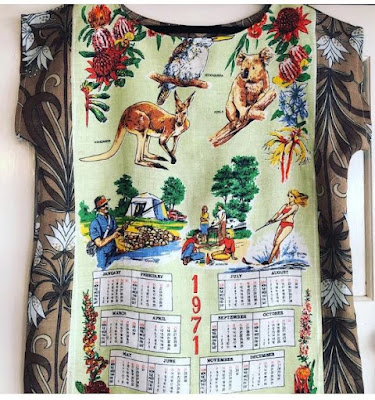
I recently ‘discovered’ (my daughter had actually been telling me to check it out for weeks!) a newish clothing and accessory shop in Wagga Wagga called Middlemost. It is named for Janene Middlemost the entrepreneur/designer/maker whose business idea it is. I wrote a piece for a local news site about her venture and designs which are deliberately eclectic and postmodern, incorporating vintage and salvaged materials, such as tea towels and furnishing fabrics not originally intended for use in clothing.They include those wonderful souvenir map and calendar style tea towels and scraps of geometric, floral and children’s designs spanning several eras.
One of Middlemost's delightful garments (image source their website https://www.middlemost.com.au/)

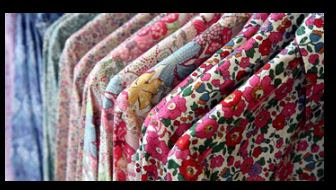
What is it about this aesthetic that appeals to me – and many others - so much? The nostalgia aspect of ‘retro’ is obvious for those of us who remember the styles of past eras, but how do we explain why people not around when ‘flower power’ and Gordon Fraser greeting cards were in their heyday still rejoice in items that use or evoke these styles? Of course good design will endure, or be rediscovered regularly. As a William Morris fan I may be biased, but I don’t think his designs have ever experienced holus bolus rejection, even in the face of staunch minimalism. Of course art nouveau and Liberty’s enjoyed a huge revival in the 1970s but they are still regularly rediscovered and introduced to new audiences. Going rural in 2014, I was surprised to discover that shirts using Liberty’s fabrics are frequently paired with moleskins by ladies of the squattocracy! 


Liberty shirts (image source http://fashiongear.fibre2fashion.com/)

The old ‘I wouldn’t hang it on my lounge room wall’ test about whether a piece of art is something you could live with has some validity when it comes to choosing the patterns and motifs we use for decor or wear. I was shocked once by a Facebook post of an affluent middle class family sitting down to dinner in front of a reproduction of Picasso’s Guernica. I didn’t think ‘wow, how edgy’ - rather I was unsettled that a work commemorating fascist atrocities could provide a back drop for the evening meal. Unless you live in MONA it is usual to want to feel a degree of comfort with your furnishing and fashions. Though personally I wouldn’t eschew all of that gallery’s holdings, Judith Lucy’s labia would be welcome on my walls! 

So what makes retro comforting? Is it possible to feel nostalgia for design trends that pre-date your existence? As a child I had a particular aversion to a teacup of my grandmother’s depicting a deep burgundy coloured rose in a hyper naturalistic lush style, a kind of Gothicised version of Royal Albert Country Roses (which I also dislike). I called it the ‘headache’ cup. Setting aside that I may have been rather neurotic, I found the motif depressing, it did not provide me with the pleasure I derived from my grandmother’s few pieces of art deco crockery with their sunny yellow, linear designs and from the cheerful fabrics mum chose for our clothes. A dress featuring golliwogs as jack-in-the box figures waving flags is embarassingly the only one preserved in a photograph.
The offending frock (author's family photo)

As the 1960s progressed, mum selected fabrics in the colourful and floral designs that characterised the decade and I happily embraced the style. She made we three sisters corduroy pinafores with tiny floral patterns in three different palettes: autumn/mauves/blues. I had a ‘twist’ dress in an emerald green striped material, with a deep ruffle around the hem that swished when I danced at birthday parties. A PVC ‘flower power’ mac with a matching hat became the most high fashion component of my pre-pubescent wardrobe (and of any other phase of my life since). I used to pray for rain so that I could wear them. I treasured my pyjama case doll with her woollen hair sprouting from a mop cap and saggy (when not stuffed with pyjamas) body of paisley fabric.

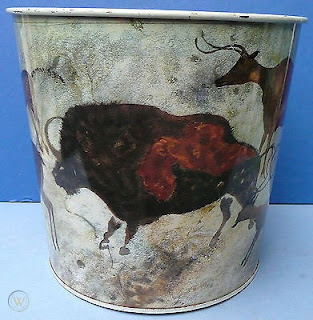
Apart from these playful aspects of 60s fashion, prehistory and Egyptology influenced our home décor. We had a wastepaper bin featuring a photographic reproduction of bison from the Lascaux caves and wallpaper in the loo depicting scantily robed female dancers and musicians based on a mural from the Tomb of Nebamun. Surely their copyright-free status was not the only attraction of these designs. 


Lascaux bison on a wastepaper bin (source https://www.worthpoint.com/). We should have hung on to it - they're collectible now!

Long before I came to understand cultural appropriation my family had place mats with Aboriginal designs on them and I baffled my teachers by using the words ‘bunyip’ and ‘dugong’ in my compositions.  I wasn’t much more enlightened in the 1980s when I copied turtle totems for a screen print design. But with hindsight the Jindyworobak movement thought 'progressive' in the 1940s, is being reassessed as naïve and even complicit in misinterpreting and exploiting Indigenous culture. 

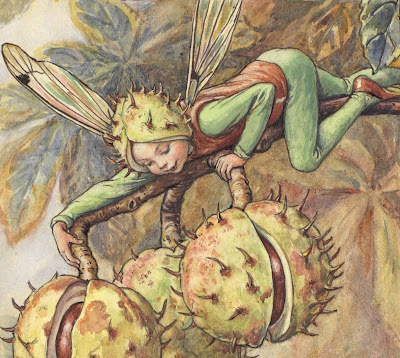
Other motifs and patterns encountered from childhood to the more recent past that continue to evoke powerful associations and, to borrow a phrase from Marie Kondo, ‘spark joy’ are Beatrix Potter’s and Molly Brett’s anthropomorphic animal characters, Cicely Mary Barker’s Flower Fairies, Arthur Rackham’s and John Tenniel’s illustrations to Alice In Wonderland, E. H. Shepherd’s to Winnie the Pooh and Harmsen van der Beek‘s to the Noddy books.
The Horse Chestnut Fairy, Flower Fairies of the Autumn, Cicely Mary Baker (source https://gardenmuseum.org.uk/)

While I was rather blasé about the Theban Necropolis–inspired wallpaper in our lavatory, I responded with awed delight at wallpaper in the bathroom of a house our family considered buying. Pink flamingos grazed for krill amongst green reeds on a black background. It was the chic-est thing I had ever seen and I wanted my parents to choose that house. But while I quite like that colour combination to this day, I wouldn’t swoon sentimentally if I saw the design reproduced now - it was hopelessly kitsch! 

As Cole Porter observed, Whistler's mama and Inferno's Dante remain 'the top' whatever the vicissitudes of fashion! Then some things have such fond associations for us that seeing them again will always elicit feelings of comfort and joy. There seem to be ‘acquired memories’ that enter the canon too. I didn’t discover Florence Broadhurst’s designs or May Gibbs’ gumnut babies until decades after their genesis but they conjure the same reaction in me as my earlier discoveries. Sometimes, however we fail to appreciate the birth of a classic. While I have spent a small fortune collecting pieces of Midwinter’s Spanish Garden design crockery because I adored a cup and saucer in that design I owned growing up, I kick myself for not investing in a complete Villeroy and Boch‘s discontinued Acapulco dinner set in the 1980s. The rebooted version is exorbitant and inferior.
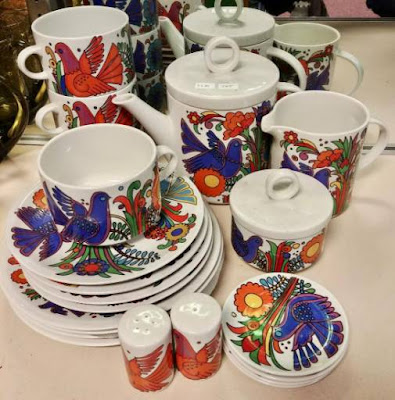
The Acapulco dinner set I wish I'd bought when it was discontinued and being sold on clearance at Prouds in the 1980s (image source https://www.liveauctioneers.com/)

I have saved the overused ‘i’ word, iconic, unil now. For me most of the designs and images I’ve mentioned here are iconic and I would also include Ladybird and Little Golden books, the Michelin Man and Aeroplane Jelly swing girl, those Amsco decals you used to see on nursery furniture, Toulouse Lautrec’s posters and Ron Campbell’s Beatles animations. These things delight in their own right and how much greater the frisson when they are skilfully combined in a nice frock or via my own rather special interior decorating style!
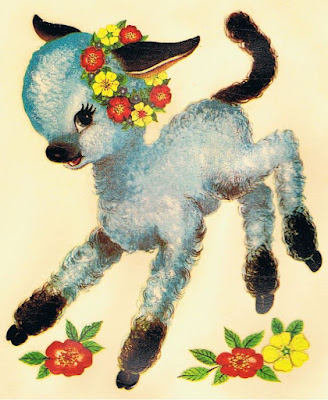
Amsco nursey decal - we had a design like this on our wardrobe (image source eBay)

But does the same effect occur when the style being recaptured or celebrated precedes your own living memory? If my parents enjoyed cave paintings and Egyptian murals, which were slightly before their time, and the Victorians loved a bit of medievalism in their architecture, perhaps we can all enjoy the exoticism of past styles… Maybe a bit of morphic resonance or collective unconscious is at work as well.
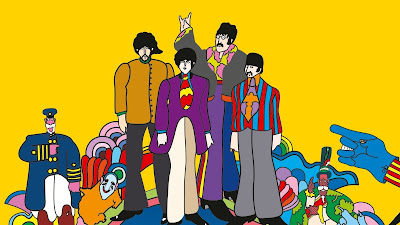
An iconic image from Yellow Submarine by Ron Campbell (source https://www.vogue.fr/fashion-culture/article/how-the-beatles-yellow-submarine-colored-pop-culture)

Tuesday, December 7, 2021

Seven Year Itch?

A few weeks ago I did some rather drastic gardening, clearing out an area that was choked with weeds in an effort to access the rain water tank we’ve never used and to get a clear view of Willans Hill from our kitchen window. Something stung or pierced my right forearm that day and it has been intermittently itchy ever since. I am used to healing more slowly as I age but I still have a rough red itchy patch that hasn’t completely cleared up. I forgot to mention it to the doctor when I saw him a few days ago for our ultimate consultation (he and his partner, both GPs, are following the well-established trend of rural GPs departing for Sydney). I am wondering if a plant fibre or insect ‘bit’ has penetrated my skin. I suppose it will either work its way out over time or enter my blood stream and kill me. My great Aunt Hannah died of a bite (either redback or scorpion, depending upon which account you read) sustained while gardening in Chatswood so there is a family precedent for such a catastrophe. I am choosing to process my itch in a more metaphorical way though… 

We’ve lived in Wagga Wagga for  seven years now. Could I be experiencing the itch that comes with that passage of time? In December 2015 I blogged about moving here. Rereading that post, it is positive about relocating, but it isn’t quite the paean to Wagga I remembered it as being. I remarked on ‘what I miss and what I welcome’ in my new environment, showing that, one year on, I was mindful of both. I knew the day would come when I was more familiar with Riverina people, locations and place names than I was with those I’d left behind. Although a trivia quiz at the recent  ‘Aqua Chicks’ Christmas party revealed my poor grasp of Wagga street names and of their family connections to various ‘chicks’. I had learnt about architect Steve O’Halloran’s legacy (he designed the Civic Theatre and is the father of an impressive  patrician aqua ‘chick’ who recited Mulga Bill’s Bicycle at the party).  I have researched the artistic hub that was the Wagga Wagga Teachers’ College (one of the teachers there, Lionel Gailor, entered his mural designs in the Sulman art prize competition in 1953 and students submitted the design for the podium for ER II’s 1954 visit to Wagga). The fast flowing Murrumbidgee and its gnarled sentinel gums still delight me, spreading development  means that we see fewer kangaroos than we did in our first year. I do now frequently bump into people I know when I am out something I craved I when I wrote that 2015 post. The passage of seven years, two of them without the option to travel, courtesy of COVID, has made me restless for occasional changes of scenery. A friend and I were poised to go to NYC and I had just got my first Australian passport when the pandemic hit. While writing this I have been able to make a flying visit to Sydney, which could be the subject of a complete other pluses and minuses post, but did mean I could see our son and catch up with friends.


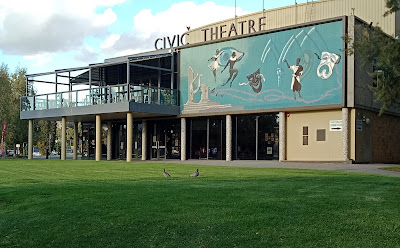
Steve O'Halloran's Civic Theatre with some modern extensions but its wonderful mural still prominent 

Most things about the tree change have been completely positive: part-time work in a congenial atmosphere, learning how not to kill plants in this soil and climate,  walking our dog Stella in the delightful Botanic Gardens and finding joy in the Booranga writers’ and book groups. I am used to sharing the house with a few dozen daddy longlegs and will never take our view for granted. I could do without the angle of the driveway (I have meniscus tears in both my knees) and I foolishly thought a modern (1970s) house would be easier to maintain than our previous Victorian and early 20th century residences. It isn’t and we aren’t getting any younger. 

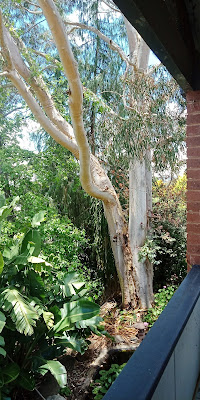
While my affection for the Riverina’s endemic gums never dims, I realise my appreciation for the enormous eucalypt in our front yard was naïve. An arborist has told us that it is not native to the Riverina but to Western Australia and suited to that dry climate. The species was chosen by local gardeners for its quick growth however its location here in a heavier rainfall region and beside our fish pond means it leaches moisture from its surrounds and has grown dangerously large, threatening to drop its substantial branches at any time. We are waiting for said arborists to make good on (i.e. not cancel at the last minute) their fourth appointment to prune the monster!


The 'monster' gum

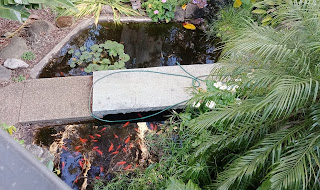
On the subject of the pond, I think I have blogged before about its maintenance requirements and how two goldfish have spawned a clan of over forty! The sight of those swirling  tangerine shoals and of little fish mouths piercing the water’s surface begging for  pellets has its own aesthetic but the banjo frogs that used to serenade us each evening have been silenced. I have seen the piscine ruffians scoffing frogspawn and even tearing apart a live frog. I am now trying to figure out a way to restore the native pond life. I’m going to ring the zoo and see if they want some gold fish – I have given away dozens in the past.


 Our fish pond - topping up the water level and and about to feed the ravenous occupants

In other aquatic news, there is now, again COVID instigated, a ceiling on numbers for aquarobics classes and I am seldom quick enough to secure a spot so my established regime is disrupted. I have bought an exercise bike but it has not won my allegiance in quite the same way. It will soon be hot enough to choreograph my own routines in our (unheated) pool, in the meantime I need to ‘get on me bike’ and generally think laterally about alternative forms of exercise. 

That is if I don’t succumb to great Aunt Hannah’s fate!

Balm for the soul (and the itch) - Wagga's Botanic Gardens

Note: all my photos.

Monday, May 17, 2021

Abundant Wonder – Tom Moore

National Glass Gallery, Wagga Wagga, NSW 

Tom Moore is one of Australia’s pre-eminent glass artists, and probably our most innovative. His retrospective exhibition, Abundant Wonder, currently showing at the National Glass Gallery, Wagga Wagga is a cornucopia of sinuous, whimsical objects showcasing  this talented artist at the peak of his powers.

This touring exhibition, commissioned by Adelaide’s Jam Factory in 2020, is the culmination of over 20 years practice and features hundreds of individual and tableau-style pieces.  It is a  technical tour de force that is also visually enchanting and provoking, humorous and disturbing. 

In a 2016 interview Moore said that his work is ‘trying to make sense of a complicated and nonsensical world’.  In doing so he repeatedly returns to the theme of  ‘human-initiated environmental damage’  through mutant figures, half machine, half animal, lush vegetable forms sprouting eyes, potato-like disembodied heads in a cabinet of curiosities and sea creatures out of their element. 

Despite their apparent organic spontaneity Moore’s objects are based on detailed drawings and are wrought through highly challenging techniques. The artist and commentators have noted the paradox of creating objects of such writhing vitality out of the rigidity of cooled glass.  Moore’s inspiration is eclectic, there is a clear evocation of pop art, think the Beatles’  'Yellow Submarine',  Reg Mombasa’s  Mambo imagery, Nickelodeon’s 'Real Monsters', Tim Burton... Two avowed influences are the drawings of nonsense poet, Edward Lear and the capriccio glass vessels of 13thC Venice.

Many of Moore’s creations are distinctly Australian in their inspiration, kangaroos with other kangaroos as heads, both roos and koalas emblazoned with lit matches, a semitrailer carrying a hammerhead shark. Re-imagined dinosaurs feature prominently too, many with tiny appended wheels that would buckle under  their ‘real life’ weight.   More playfulness with his materials! Every fabrication is simultaneously both delightfully amusing and expressive of  his deeper concern for the planet under threat.


The  theatricality and dynamic qualities of Moore’s work makes it ripe for  animation and a major component of the exhibition is the digitally created videos depicting his hybrid creatures in fantasy landscapes blinking, flying,  spinning, consuming one another and even exploding – his favourite effect! 

All this richness  and grotesquery is displayed  in the reassuringly familiar setting of cubby houses and puppet show  booths, storybook illustrations and  alphabet blocks. Thus we are soothed and beguiled only to be confronted and disturbed.

Do see Abundant Wonder. It is in Wagga Wagga until 4 July then travelling to Victoria, Queensland and South Australia. For details visit: https://www.mooreismore.com/abundant-wonder-exhibition-and-tour/


Thursday, October 24, 2019

Interwoven

It’s funny how apparently unrelated threads in our lives can intertwine and how we sometimes hit upon unknown facts about people that resonate deeply with us. In the last couple of years I have discovered the unknown (to me) talents of two friends  and an unsuspected connection between their lives and mine. These disparate skeins have become woven together in a way that is both bittersweet and cathartic.

Diablo Mode was big, dark and hirsute. A bear.  I met him when he was the newish partner of our long-time friend and former neighbour John Stone. John is a bear too. But grizzly. I sat on their deck in Stanmore and admired the assorted boots, joggers, and lone leather motorcycle glove, hanging on the fence, sprouting succulents. They looked quirky, a bit random and a bit curated. ‘That’s Diablo’s work’ said John. I looked around and soon saw other evidence of Diablo’s creativity: objects combining manufactured elements like thread, copper wire and brass tacks with native grasses and seed pods.


Diablo Mode (aka James David Gardener) 

As well as being John’s witty, saturnine companion who lent me a sympathetic ear and settled me down to rest on their window seat when I got drunk after a fight with my sister, Diablo was an artist!

His earliest work was playful, impermanent. With chalk he drew stitch patterns over cracks in pavements and masonry and traced the outlines of shadows cast by streetlights leaving evocative after-images when the sun rose.  He came under the influences of surrealism, and its sister movement Dada, making slyly homoerotic collages and sculptures, increasingly incorporating found objects. As he matured as an artist Diablo was affected by a rich range of other influences and produced work of increasing originality and sophistication. On an art school trip to Central Australia he found his true metier: weaving using a combination of Australian native flora  and man-made elements.  


Examples of Diablo's work blending natural and manufactured elements 

Diablo Mode was also known as  James David Gardner and he died suddenly in the early hours of 25 October 2018 aged only 45.

John was poleaxed. Sydney friends and artists rallied and arranged a fittingly flamboyant wake within days. Five hours away in Wagga, with a husband who had just had a heart attack, I couldn’t make it. John sent us a link to the slide show. The art impressed me, blending those industrial and botanic materials into forms that belied their fragility and impermanence. The pictures and videos of them together taking their dog, Bodhi, on road trips, walks and swimming undid me.


John, Bodhi & Diablo on a road trip in their van 

Now John was faced with the challenge of re-homing Diablo’s vast stock of works in progress, art tools, accumulated found objects and botanic materials. Most could go to his family, but a destination for the painstakingly accumulated raw and prepared botanical materials needed to be found.


Aunty Kath Withers in her studio in Wagga Wagga not long after her diagnosis

I first met Aunty Kath Withers during my short-lived career with Riverina TAFE. A revered Wiradjuri elder, she taught art at Junee Gaol. In its wisdom, the New South Wales vocational education system insisted she acquire a formal qualification to continue to do so. I met her weekly in the library and we quickly formed a bond over fathoming the weasel words and coyote concepts that make up vocational  training ‘packages’ and the byzantine complexity of TAFE’s eLearning system.

Aunty Kath got a diagnosis of breast cancer a few weeks in and we took a break so she could undergo treatment.  For some reason during that interval TAFE decided not to fund any more of our sessions together. Kath and I stayed in touch. I saw her give the welcome to country at several events and she invited us to her exhibition Looking Forward, Looking Back at the Wagga Art Gallery.  The breadth of her artistic output, which includes print-making, painting, pokerwork and weaving, often referencing her childhood in Wagga’s Tin Town, astounded me. We have two of her pieces, Murrumbidgee Dreaming and New Beginnings, on our walls.


Work produced at Aunty Kath's weaving workshops

Despite an increasing success as a practising artist, Auntie Kath says her greatest joy is passing on her cultural knowledge and technical skills by running workshops, particularly weaving workshops.

An idea began to form…

Maybe Diablo’s botanic stockpile could travel the 450 km from Sydney’s inner west to Tatton in Wagga Wagga. There it could fulfil its destiny in Aunty Kath’s hands and those of her workshop participants. I talked to her and to John about it and early in 2019 John arrived in Wagga with Bodhi and a van full of treasures.


Delivering some of Diablo's botanic materials left to right: me, Kath and John

Delivering the cache and chatting we discovered a beautiful synergy.  Diablo and Kath had both learnt from the same mentor, the extraordinary and acclaimed basket weaver Virginia Kaiser. To compound the coincidence, I had also known Virginia, and packaged her work for an exhibition in Teheran, during my time at Craft Australia in the 1990s. It is extremely satisfying that our disparate paths have dovetailed like this. John  and others who knew Diablo agree that his materials are in good hands and will continue to be used by artists. It feels as though we are preserving an important legacy and perhaps contributing to the creation of new ones.


 In Memory of  James David Gardner (1973 - 2018)

NOTE: All images are reproduced with permission of Kath Withers and John Stone.


Sources:


Conversations with John Stone and Aunty Kath Withers
Carmichael, R. Gordon, Catalogue essay ‘Don’t Ever Stop’ retrospective exhibition of Diablo Mode’s work 2019
Recharge, relax, relearn/Brooke Munro @ Dirty Janes Bowral, 
 2017 – accessed September 2019
City of Wagga Wagga Council website – various pages - accessed September 2019

For more about these artists visit

Diablo Mode

Aunty Kath Withers

Virginia Kaiser


Monday, December 7, 2015

The year of living curiously


I was curious to know what it would be like to live in another place. I was curious to know what it would be like to have a husband who was happy at work and in his skin. Curious to see what cutting free from my public service moorings and courting uncertainty would bring. Curious to experience a different climate, terrain and tempo. Curious to see fresh sights, make new friends and have the time to write.

Curiosity led me to the bush. To the achingly blue skies, unyielding red rock and sinuous mottle-barked gums of the Riverina.   Curiosity killed my cat and rabbits. Curiosity revealed timid black-faced wallabies, spongy-toed marbled geckoes and neat little wood ducks as well as countless tranquil riverside walking tracks.  Curiosity led me to discover unimagined links to our new home. There was my husband's great grandfather, a Melbourne timber getter who tried his hand at taking the telegraph through Tarcutta to Gundagai and perished with a fractured spine in Wagga’s misnamed Hope Inn in 1860. There was the redoubtable, community minded manager of the Union Bank in Henty  and his wife, doyenne of the CWA and debutante balls, and their daughter, my enigmatic third cousin, Norma - they played golf, taught textile arts, judged flower shows and kept Shakespeare alive in the district for over 30 years.

Curiosity precedes uncertainty and is its companion. Once moorings are slipped and routines shed it is necessary to be open, to allow yourself the excitement and discomfort of the unfamiliar.  I hear myself maybe too often pronouncing on the differences between my urban and rural lives. I am noticing what I miss and what I welcome. No salt tang of Sydney Harbour in the air but the nutty smell of Wagga earth and grasses.  Fewer choices to get and to do things, yet such economy and ease of getting and doing.  The strangeness of knowing none of the people you see in the street then the excitement when you start to bump into and chat to new acquaintances.

It has been a year of loss and learning, of loneliness and privilege. I have yearned to see those I love who are now far away and cherished the rare moments I have spent time with them or talked to them. Rejoiced that the internet keeps ties strong and enables sharing of both the profound and the trivial. 

Someone’s momma once said ‘You can’t hurry love, you just have to wait, love don’t come easily, it’s a game of give and take’. The same is true of adjusting to change. Some if it is active pursuit and embrace but much is just openness and  can’t be forced.   A year of curiosity shows us our capacities and  limits, shows us when we baulk or resile  and how we can grow and bend.   It reminds us to continually reassess our perceptions and recalibrate our comfort settings, with compassion towards ourselves and others.  

As Buddhist teacher, Pema Chodron says:

Rather than going after our walls and barriers with a sledgehammer, we pay attention to them. With gentleness and honesty, we move closer to those walls. We touch them and smell them and get to know them well. We begin the process of acknowledging our aversions and our cravings.  We become familiar with the strategies and beliefs we use to build the walls: What are the stories I tell myself? What repels me and what attracts me? We start to get curious about what is going on.

I expect and hope to get curiouser and curiouser.


Monday, April 6, 2015

Eight legs bad?

“And God made the beasts of the earth according to their kinds and the marsupials of the bush according to their kinds, and everything that creeps, slithers and scurries upon the ground according to their kinds, and even the sneaky cats who pounce on anything that creeps, slithers or scurries according to their kinds. Not to mention any number of things that bite, sting, build webby structures to ensnare the unwary or just look really menacing according to their kinds. And God can’t seriously have seen that it was good. At the very least he must have admitted that his creation was a bit fraught with moral dilemmas, I mean, really, was he having a laugh or what?” (Genesis 1: 25 – paraphrased). 

So it’s month seven in the antipodean garden of Eden that is Wagga WaggaNew South Wales! I would like to say that the body count had stabilised at minus two rabbits and one cat but although the latest casualties have not come from amongst the ranks of our pets the carnage goes on.  I have lost count of the variety of dead things, or bits thereof, I have seen.


John Percival's 1951 image of an Australian Garden of Eden (just like Wagga Wagga but without spiders)


Portents were here from the beginning had I but heeded them. There was a cow skull attached to the aviary when we arrived, we've found a wombat skull and several other skeletal remains strewn about in the bushland behind our house. The roads on the journey to Wagga featured plenty of the grey/pink sludge that speaks of ex foxes, rabbits, 'roos and possums.  Death was and  is omnipresent.  


Local skulls 

Notwithstanding the Christian reference I began with, I am now going to go all Hindu and suggest that the demise of any living thing could be viewed as diminishing us all. As a nature lover I have always thought along those lines. However, in later life I am having to harden the hell up! Otherwise I would be in perpetual mourning.

Some deaths come from the indifference of nature like the freak storm one afternoon that brought the temperature plummeting by about twenty degrees and saw off our koi carp, or the strong winds that dislodge the odd nest of fledglings. These deaths I can view as sad but unavoidable.

Many more deaths though are the result of human impact (and here the guilt starts to seep in). The trappings of civilisation we invaders have brought to the bush like the chlorinated pool water that defeated a naive little frog and the swift, convenient vehicles that plough into nocturnal animals. Then there are the expired skinks and small birds that have met their ends courtesy of our supposedly ‘indoor’ rescue cats.

However my own deep, personal shame is that I am now an agent of death -  I regularly commit arachnicide! Is it the thin edge of the wedge? Will it be long before I join the Hunters and Fishers party?

My metropolitan philosophy had ever been to gently evict any creepy crawly that attempted to share our living space, this is how I came to justify a more drastic solution.

For weeks there lurked in the crevices of the rocks around the pool an abundance of spider types. At least a third of them were red backs and although I was assured that their fangs cannot pierce human, canine or feline skin I let my fear and repugnance get the better of me. Soon I was using insecticide, water jets and the base of a thong to despatch them. These weapons (apart from the thongs) knew no nice distinctions and many harmless grass spiders met premature ends in the purge.


Pool (and everywhere else) lounger  

Then there was huntsman season. Something just snapped when my 3 a.m. lunges with upturned Tupperware at the biggest bloody huntsman I've ever seen on the pelmet in my daughter’s room proved completely useless and the monster just scurried about menacingly.  I  protested not one jot when my son tried to ‘take out’ the spider in a more final way than I had planned. He used the plastic wrapped rolled Herald like a kind of javelin/snooker cue hybrid and thrust it at the creature. The spider retreated  between the slats of the blinds and I found one of its legs, though not the rest of it, on the window sill the next day. Within a week its relations were all over the joint and we became quite blasé about removing them with no care for their well-being. Next the humble daddy long legs fell victim to my callousness. So abundant and prolific are they that you can denude a room  of them one day and find five or six in residence again the next.


A simulation of the huntsman on the bedroom wall scenario 
although this one is MUCH smaller!

In fact it is a Waggan thing that spiders and their webs simply abound! The eaves and window frames of every building, the wheels, doors and wing mirrors of every car and the extremities of many plants are festooned with webs that are remade within twenty four hours of being removed. If you have seen the photos taken after the Wagga floods you will know that the local spiders are incredibly resourceful and tenacious. Not for them the watery death facing other fauna, they simply established housing developments atop anything that stuck out above flood level.


The Wagga Wide Web

They say familiarity breeds contempt and just as I hardly gave squishing a cockroach a second thought in Sydney I now view spiders’ invasiveness  - we have found red backs on the stairs, the kitchen counter, the roll-a-door,  sunning themselves amongst my pot plants and lolling poolside as I mentioned before – as justifying my culling. Their prevalence and audacity make me feel vindicated.

So though my heart is still heavy when I think of the deaths of our erstwhile pets or remove the victims of our current ones, and I grieve at the carnage on the roads, I cannot find it in myself to allow Waggan spiders a share in our joint divinity. I consider them expendable, like Sydney cockroaches. Could I be on  on the slippery slope to worse moral relativism?  I hope I am not accruing too much bad karma,  I only squash the red backs though I may have, inadvertently, vacuumed up a couple of other species.


After the deluge, survival of the webbiest.


Oops!