Showing posts with label rabbit. Show all posts

Saturday, October 17, 2020

Bunny Ambivalence

Rabbits are not native to Australia but, along with other European pests, arrived by ship in 1788. Within 50 years they were endemic. 

In January 1912 Mr James McGrory of Willarma Station near Yass claimed in a report published in the Hillston Spectator & Lachlan River Advertiser that he had poisoned and collected the corpses of 5000 rabbits in one night, he volunteered three witnesses in case readers disbelieved him.

Record rabbit catch in the Riverina, The Sydney Mail 28 August 1912

Later that year the Manager of Wagga Wagga’s Borambola Station, Mr A.P. Wade, boasted a haul of 2000 rabbits in a single night to the Sydney Mail. The newspaper’s photograph of his inert quarry, arranged with Kondo-esque neatness, is reproduced above.   

As recently as February 2012, the ABC news website reported Riverina shooters culling more than 1000 bunnies each night. 

Just a week ago I went for coffee at the Lucid café in Gurwood Street (the ‘Paris end’ of Wagga) and saw a miniature lop eared bunny with markings resembling a Hercules Poirot moustache, fluffily hopping around nibbling pellets and carrot sticks. When she was ready to leave, its owner (appropriately enough) popped it into her handbag a la Paris Hilton! 

Currently on Gumtree miniature rex & lop eared bunnies are available in Wagga and Thurgoona for between $30 and $120.   

Australia exported frozen rabbit meat and pelts to Britain from the 1890s onwards. Rabbit stew was a favourite dish in ‘the old country’ and no less here where its economical and nutritious qualities sustained many a family during the Great Depression.  In the 1940s and 50s rabbit stew was still a rural favourite cooked over fires in rabbiters’ camps and, according to the Daily Advertiser of 15 January 1952,  introduced to city lads like Noel Mannering, Bill Pask and Peter Giles when they ‘went bush’ to celebrate the end of their apprenticeship training.  Ah, that 'schoolies' was as benign these days!

In the 21st century, two of Wagga’s most cherished institutions are Cottontails Harefield Vineyard & Restaurant and the Curious Rabbit Gallery-Café-Bookshop. 

Signage for arts hub in Wagga Wagga (the Paris end) referencing Alice in Wonderland 

I think it would be accurate to say that this town has an ambivalent relationship with the lagomorph. 

My own relationship with the species has also waxed and waned. An English childhood ensured that Beatrix Potter’s tales primed me to want bunnies as pets. I was given a pair when I was about nine. Benjamin was named for Potter’s creation, I can’t recall the name of his sibling. They were quite nasty and aggressive. Far from donning tam-o’-shanters and engaging in delightful whimsy, they scratched and bit me whenever I attempted to handle them or clean out their hutch and escaped to a neighbour’s (not Mr MacGregor’s) garden the first chance they got. 


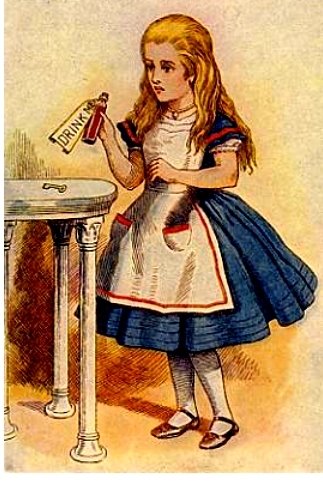
Tenniel's and Potter's rabbits - my childhood bunny ideals

Despite this disappointing real life encounter, the rabbits in the books I read were consistently endearing. As well as Benjamin there was Peter and the Flopsies (we had an EP of Vivienne Leigh telling their story and singing “We don’t care, we don’t care, we don’t care a fig, there’s a cabbage in the larder though it isn’t very big (and any way tomorrow is another day!)” There was Lewis Carroll’s timid, tardy white rabbit who beguiled Alice into taking that plunge into Wonderland. There were Hazel, FiverCampion and Bigwig making the epic journey to Watership Down in Richard Adams’ 1972 novel. There were Jane Pilgrim’s delightful Blackberry Farm books and Enid Blyton’s adaptations of the Brer Rabbit  stories. 

I was not to get close up and personal with bunnies again for many years to come. Soon after arriving in Australia it was evident that rabbits were considered vermin here and subject to a variety of eradication techniques from baits to fumigation, from  buckshot to germ warfare*. Their fur was also the chief material used in Australia’s national hat, the Akubra. 

Sam Hood's 1927 photograph of Fort Street school boys being shown how Akubra hats were produced - some distinctly ex-looking bunnies as props.

It was quite by chance that we came to own a succession of pet rabbits in the 2000s. When we still lived in Sydney suburbia a litter was born under a neighbour’s house and one, whom my daughter named Leslie, hopped into our lives. We had him less than a fortnight when our ginger cat, Simon chased him and gave him a bunny cardiac arrest. My daughter was bereft and we actually paid good cash money for his replacement, a dwarf  lop eared rabbit called Waldorf (after a block of apartments we passed in Parramatta en route to collect him). Waldorf had a mischievous and engaging nature. He spent some time in his hutch but plenty with us in the house. Our Friday night ritual was for the family to occupy the sofa and to seat him on the window sill behind us as we shared a Cadbury’s family block with him and watched a movie. Waldorf’s life was short – he disappeared one night, probably the victim of a dog, fox or owl - but evidence was that he had fulfilled his destiny with a neighbour’s doe as we saw his likenesses hopping about the street a few weeks after his demise.

Waldorf being forced to endure a white rabbit trope - he hated that fob watch and immediately chucked it off the settee

After Waldorf we had Doris, Brian and Stuie – all blow-ins, or hop-ins, and perhaps  (at least the first two who had lop ears) Waldorf’s descendants. Their fate was sealed when we moved to Wagga. They did not cope well and succumbed, we thought at the time, to the heat, but now I wonder if they caught calicivirus. Any way all three perished within a few months of relocation. Strange thing was that there was another bunny hopping about, a fawn coloured beauty. An abandoned packet of pellets and an empty hutch told us it had been the former residents’ pet. It seemed well adapted to the climate but our neighbour ran it over in her 4 wheel drive.   

So the Riverina is no place for rabbits unless they are on a wine bottle label or a bookstore’s signage. However wild ones do abound so I guess the rifle totin’ locals can still catch a cheap tasty feed  or contribute to the Akubra supply chain!

*Anthropomorphic and cute though bunnies may have been in British literature I realised on a trip back to the UK in 1984 that the country of my birth had also tried to wipe out wild lagomorphs (although they were not an introduced species there), with the myxomatosis virus. We encountered an ailing rabbit on a drive through country lanes and after ‘rescuing’ it my Uncle Ken had to dispatch it with a resounding ‘thunk’ of his shovel. 

Friday, November 28, 2014

Not Properly Introduced?


Losing our two rabbits and a beloved cat in a single week (to the heat and a brown snake) in our first few weeks in Wagga has led me to reflect on my naivety about the risks our new environment poses and to ponder the strange accidents of history that have put this fairly Anglo family, with its predilection for William Morris arts and crafts and Beatrix Potter-style anthropomorphised pets, in the middle of the Australian bush.

I have been piecing together what Australian history I already knew and what I am learning about the Riverina region specifically to help make sense of my feelings – feelings of loss and displacement side by side with those of exhilaration and rapidly growing love of this landscape and town.

Such sudden evidence of the vulnerability of our urban pets has driven home to me with brutal intensity how paper bark thin is the veneer of suburban decorum here.  Kooringal’s winding streets sport bright green sprinkler-fed lawns,  garden beds of foxgloves and heliotrope and faux classical embellishments adorn the houses, yet many of those houses, like ours,  back onto  rugged, rocky terrain where heatstroke, snakebite and god knows what other perils await. When the sun is relentless and the air is humming I can’t avoid visions of Miranda and her school friends vanishing!

Disappearing into the impenetrable mysteries of the bush, Picnic At Hanging Rock.

I found an unattributed poem* published in the Wagga Wagga  Daily Advertiser of 25th November, 1941 (65 years  to the day that I am writing this). It expresses the solace provided by quiet reflection on the banks of Wollundry Lagoon, on how the things of Nature, God's kind forgiving smile’ help to heal both the soldier’s mind still full of the ‘frenzy of Tobruk’ and the troubled soul of  ‘some forlorn, weak sister’ who has morally transgressed. Then the poet suddenly conjures up images from the distant past:

(When) in Wollundry's garden a vision strange appears
Of native children playing among the ancient trees,
And camp smoke slowly rising upon the languid breeze.
No trim lawns then and willows, or fragrant scent of rose;
Long reeds and waving grasses, and calling of the crows.
Here dark-skinned men and women; God's creatures yet untamed
Lived innocently happy, untutored and unashamed.
They heard the kookaburra with cheery laughter greet
The sunglow, overspreading the morning, dewy sweet.
They saw the wild duck leaving their night-enchanted haunts
And took what Nature offered to satisfy their wants.
The kangaroos leaped lightly, the emu loitered near
Sufficient for the hunting, the boomerang and spear.
The native life was simple. Its savagery was mild.
And heart, however cultured, still leaneth to the wild.
There is something very pleasing in unspoilt forest still.
Ere man with axe and fire has worked his ruthless will
There heaven-assisted Nature moulds in unrivalled way
Her monumental splendour from elemental clay.

Despite its romantic paternalism (and inaccuracy about who first used fire to manage the land), the poet is attempting some 100 years after Wagga’s genesis as a European town, to grapple with the same paradoxes I am.  To reconcile what consoles her of contemporary values and taste with an imagined past she admires  as elemental, innocent and unspoilt.  She quickly excuses herself from judgement with the line “And who shall say the old thing was better than the new?”


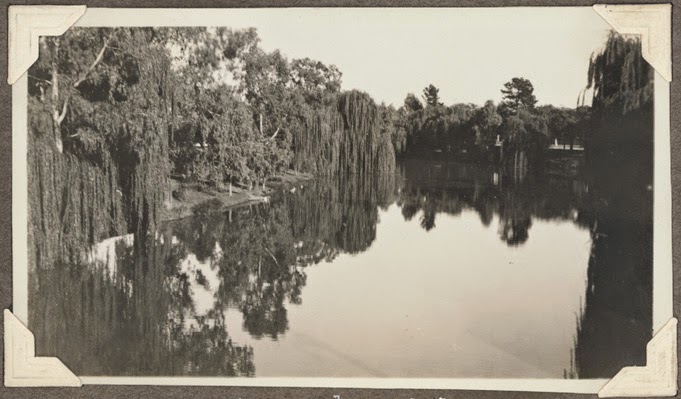
The willows of Wollundry Lagoon in the 1930s (NSW State Records)

But we all do, constantly, declare an old thing better than a new or a new thing better than an old. When land was cleared for grazing in the early-mid 19thC the practice was supported by progressive,  benevolent natural scientist and  pioneer authority on Aboriginal culture, Alfred William Howitt, as ridding the land of miasma producing toxins. Also, as Wagga poet and memoirist, Mary Gilmore relates, sheep and cattle station owners saw the plants and birds which had flourished in  sanctuaries preserved by the local Wiradjuri  people for centuries on the Murrumbidgee as hazards and impositions. They eradicated the river oaks completely and drove the black swans from their nests smashing their eggs. They believed they were cleansing the landscape to better provide for their families, they had no inkling of the salinity that was to affect the soil so soon afterwards.  Regeneration of bush and wetlands decades later shows the old reasserting itself against the new!

We didn’t see  the brown snake get our cat. My son had seen it  earlier in the day winding away from the fishpond, and I had not thought anything of it when he told me. Her symptoms however, back legs giving way with ascending paralysis, venom affecting her breathing muscles and her mouth frothing up, were textbook. I realised that when I did some reading later. We don’t know for sure that the rabbits succumbed to heat exhaustion. They may have dehydrated, rabbits in the city don’t need drinking water you just dampen their veggies. As with the death of any loved one my mind raced with questions about what I could have done to keep my pets from harm.


Backyard grave for two of our perished pets - memorial mound of local rock.

As classes,  cats and rabbits are rightly considered destructive introduced  pests in Australia yet this particular cat and these particular rabbits did no damage, they just proved fragile in the face of the perennial dangers of the bush. Should we have introduced them at all? Done so differently? Or, like our sprinkler-addicted neighbours, should we defy the environment because we enjoy the company of our effete European pets?


These questions can’t be answered. All human society is rife with contradiction and compromise. This land is the brown snake’s home and it is also home to Maltese terriers, McDonalds drive thru,  alyssum borders, fancy garden statuary from Bunning’s and now also home to our 'rescue' new cats. We hope that,  like currency lads and lasses, being Wagga born, they may be prove more robust in this environment.   

Whatever comes there will be sadness and there will always be consolation amongst the willows and the now reintroduced river oaks of Wollundry Lagoon.


River Oaks (Casuarina cunninghamiana) back beside Wollundry Lagoon.

*Have contacted Editor of the Daily Advertiser to try to trace author with no success.


Saturday, December 5, 2009

Farewell Waldorf

Waldorf's time on earth was limited but he used it to his utmost.

Our bunny of less than a year, Waldorf, was last seen at 3 am last Sunday. After several short- lived attempts to join the feral rabbits over the road he succeeded in leaving his genetic legacy there about 2 weeks ago (we saw him in congress with the little brown one). Then, presumably on a return visit, he must have succumbed to a dog or fox or even an owl. There is not hide nor hare (sorry) of him to be found...

Here is his farewell song (to the tune of '
*Raggle Taggle Gypsies' - with apologies to 'Trad' - oh, and he had an Irish accent)

Three bunnies stood at our front gate. They jumped so high, they jumped so low


Waldorf sat in his hutch quite late. His heart it melted away like snow

They smelt so sweet, they bounced so cute that fast his tail began to twitch


As he lay on his lucerne bed, he started to feel a ceaseless itch.


He slipped the latch of his high class hutch all made of treated wood-o


He hopped to the street all stealthy like & went out in the weather & the mud-o

Avert yer eyes, leave open the gate, to roister and frolic is my intent

I’ll ne’r return to my hoi class hutch – till I secure moi heart’s content..


So oi’m off with the raggle taggle bunnies-o! (so I am)

He hopped high and he hopped low, he scampered the length of Bellbird Street


Until he came to a neighbour’s lawn and there spied a-laydee bunny-o


She nuzzled his head, she looked in his eye, and this is what she said-o:

"What makes you leave your hutch and lucerne & your golden bunny muesli-o?


What makes you leave your human slaves to join us raggle taggle bunnies-o?"

"What care I for my hutch and lucerne? What care I for my humans-o?


What care I for my buckwheat treats? I'm off with the raggle taggle bunnies-o! (So I am)"

"Last night you slept on a fluffy towel, with a layer of lucerne spread o’er – o


Tonight you sleep in a grotty ditch along with some raggle taggle bunnies-o!"

"What care I for a fluffy towel, with a layer of lucerne spread o’er-o?


When I can sleep with a laydee bunny -
the best of those raggle taggle bunnies-o!"


Farewell, Waldorf - I would never have thought a bunny could be so delightful, mischievous, clever, infuriating and loveable!


* Click here for The Chieftains version.


Saturday, June 20, 2009

Woman obsessed with rabbits?

It has been brought to my attention that some of my readers (well, 2 work colleagues in particular) think I am a woman obsessed with rabbits because of the number of times Waldorf features in this blog and in my conversation. Now while I am very concerned with Waldorf's welfare (he’s got out again as I type this), I am not a woman obsessed with rabbits, Miriam Sakewitz is a woman obsessed with rabbits!

An Associated Press story reproduced in yesterday’s Sydney Morning Herald (19 June 2009) states that Miriam Sakewitz was arrested in a hotel room in Oregon with more than a dozen rabbits, eight adults and half a dozen babies, ‘some caged, some roaming’.

The story went on to say that she had a history of consorting with bunnies and had been arrested in 2007 for living with more than 250 rabbits ‘in squalid conditions’. In a plea deal she was released but forbidden to have the animals for five years. She was arrested four months later when, unable to endure such privation, she stole back one of her pets from a holding pen.

Presumably she is now sans lapins and in ‘the pen’ herself!

I am fond of animals, there is no denying it. In my time I have raised mice and kittens by dropper and taken in stray cats and dogs either as additions to our household or until we could find homes for them. Since becoming a parent nurturing my children and our pets has probably taken on new dimensions. However, rabbits do not have pride of place in my menagerie. I had 2 as a child and they were antisocial, unpleasant creatures that kicked me incessantly. I was quite pleased when they escaped!

Perhaps it is time I profiled the staffies and the moggies in my blog?


Alice/Miriam trying to self actualise by chasing the white rabbit!

Sunday, May 31, 2009

Ground control to Major Tom: you've lost us!

Our weekend has revolved around seeking medical and veterinary attention for our daughter and our rabbit respectively. Thankfully neither has swine flu!


Our bunny, Waldorf, has a torn ear and has been inoculated against myxomatosis and the calicivirus; our daughter has tonsillitis, had a severe migraine and has had a penicillin injection! Waldorf hopped the coop on Friday and was missing in hellish cold rainy weather for hours. We only recovered him, bloody eared, from a neighbour’s garden 5 minutes before the last episode of the US version of ‘Life On Mars’ was shown at 10.30 pm.


He must have squeezed out under the side gate (and grazed his ear in the process) at about 9.15 that morning when I left for work. Then, unbeknown to us, he had roamed the street – being spied by various neighbours throughout the day - and finally made his way to the house over the road (where Lesley came from and where 2 of Lesley’s siblings still roam free) in search of company and a chance to do what bunnies do best.I wondered, if cats have 9 lives, how many do rabbits have? It would have to be fewer I think and he is courting disaster by breaking out like that. My husband took him to the vet for the aforementioned inoculations and to have his ear tended to on Saturday morning


Within about an hour of his return to the bosom of the family our daughter was suffering visual disturbances and searing pain in her head that no kind of analgesia would touch. 1 GP visit and 1 penicillin injection later she was still in great pain and it was RPA Emergency here we come. It was 8.30 pm when her dehydration was finally overcome and the series of painkillers I’d administered earlier kicked in. My husband went in search of fish and chips which was what she fancied after eating virtually nothing all day. We consumed them while ‘Mr Blandings Buil(t) His Dream House’ (on ABC2) for the umpteenth time! Today she is feeling much better and Waldorf has been hiding under the house all day in protest at our curtailing his love life.


Shame about the ending of the US ‘Life On Mars’ – although not in the same league as its British inspiration we had been enjoying it. The dénouement was extremely silly. You had to feel for the actors neatly and sentimentally making twee sense of the series engagingly implausible premise. I am no enemy of the pun, but 'this is going to be one successful gene hunt'! Pulease!


Philip Glenister and Harvey Keitel (UK and US Gene Hunt respectively) look disappointed in the final episode of the US version of Life On Mars which was all wrapped up too cutely.