Sunday, May 15, 2022

Still a bit in the dark about Eleanor


Brooks' and Clark's biography of Australian author Eleanor Dark, 
Pan McMillan 1998 (my photograph).

I enjoy reading biographies.  Well-researched and written biographies provide insights into the subject’s career and character and illuminate an era. They can be immensely pleasurable and even transporting to read. Norman Mailer’s Oswald’s Tale, John Lahr’s Prick Up Your Ears, Nadia Wheatley’s The Life and Myth of Charmian Clift and Hayden Herrera’s Frida all achieved that for me.   Two of those are quite hefty tomes, and another enjoyable read, Peter Ackroyd’s Dickens, is over 1000 pages.  So length is not a disincentive for me if the author keeps my interest and genuinely evokes the texture of its subject’s life and times.

Disappointingly though, Eleanor Dark - A Writer’s Life by Barbara Brooks (with Judith Clark) published by Pan McMillan Australia 1998 did not reward my perseverance through its 488 pages.   I confess I have not read any of Eleanor Dark’s novels though I had certainly heard of The Timeless Land.  I fully intend to read some now as this biography’s painstaking recounting of the plot of each of her works, replete with large slabs of quoted text, made me yearn for the source uninterrupted by commentary on what Miles Franklin or Nettie Palmer thought.  The frequent quotes from correspondence and reviews only serve to show that tastes differ and that few books are 100% successful in achieving what the writer sets out to do. They were overused and tedious, an exception being this response to The Timeless Land from US poet, Karl Shapiro which is so delightful that it made me resolve to track down his work.

(The Timeless Land) has left a wonderful flavor with me. It’s andante, acrid, blue, warm as sky,  inwoven like tapestry,  hung in that  space of Australian atmosphere, not quite tragic, wiser than nostalgia full of peace. (What a jumble of epithets that is)…  (quoted p. 360).


US poet Karl Shapiro on leave in Katoomba during WW2, possibly at the Dark's home, Varuna (source: Blue Mountains Library)

Between 1934 and 1953 Eleanor Dark published 10 novels. She was initially known for her challenging, sometimes melodramatic, subject matter and a modernist style likened to Virginia Woolf’s. From 1941 and thereafter  she became synonymous with the epic historical saga of Australia’s early colonial days known collectively as The Timeless Land after the first novel in a trilogy which also included Storm of Time (1948) and No Barrier (1953)

Towards the end of her career, Eleanor Dark only wrote intermittently and was not satisfied with what she produced.  She published nothing new between 1956 and her death in 1985. Always restless and self-critical, Eleanor described herself (as the thinly disguised protagonist in an abandoned draft) as merely a ‘competent’ writer. I suspect she was being harsh but I have yet to experience her prose outside the clumps reproduced by Brooks.

The portrait of Eleanor Dark that emerges from this biography is of a cerebral rather aloof person with a strong social conscience and a belief in the lessons of history who did not suffer fools or organised politics gladly.  Retreating from a dysfunctional and fragmented family life she and husband Dr Eric Dark forged themselves a comfortable middle class existence in their spacious Katoomba house where Eleanor was able to write full-time  (notwithstanding maternal and domestic responsibilities which on a bad day irritated her significantly). She and Eric were part of the Blue Mountains intellectual set, great readers and theatre goers and keen bush walkers Eleanor’s spent many hours in the garden of their property Varuna incorporate cultivating native species, an environmentalist before the term was coined.  Both were committed to the Blue Mountains community, Eric offering affordable medical care to patients many decades before Medibank was introduced. The Darks were instrumental in organising child care and a library for evacuee children during WW2. Eleanor was supportive of her husband’s politics, more overtly socialist than her own, and both suffered from reactionary public opinion during the McCarthyist era.

In The Timeless Land and a 1944 essay for The Weekend Book , Eleanor  represented the truth about British colonisation of  Australia, in the latter  using the phrase ‘we stole their land’ in relation to the myth of terra nullius and the dispossession of the Aboriginal people probably for the first time in Australian writing

So, there is much I read in Brooks’ book that makes me admire and like Eleanor Dark before even opening the pages of any of her own work. But after 488 pages she still felt like a cypher to me. Her complex relationship with her father and his legacy, her reaction to her mother’s early death, the lukewarm reception she appears to have given the stepson she gained on marriage and the depression and ill health of her final years are all touched on very lightly. I felt there was more to say about these aspects of her life and how they forged her personality and the themes in her writing. A friend of mine who knows her descendants says Eleanor was much warmer than the biography suggests and that her family life was not as dull and serene as it seems from the pages of Brooks’ book.

I am very dutiful  when it comes to finishing a book I start and despite its shortcomings I am glad I read Eleanor Dark - A Writer’s Life to the end because  it has lead me to want to read Eleanor Dark’s books. Then there is her feminism, albeit a feminism that still adopted the pronoun ‘he’ for all humanity, her incorporation of an Aboriginal perspective in The Timeless Land, even if we may now consider her technique cultural appropriation, her apparently amazing evocation of contemporary Sydney in Waterway (1938) and a potential affinity with Virginia Woolf - all of which I am keen to encounter.

There are two ideas of Eleanor’s Brookes communicates which will really resonate with modern readers and which were revolutionary in her era. One is her view on white Australians’ relationship with the land: saying that in their quest to conquer a land perceived as hostile  Europeans had created ‘deserts and dustbowls, wasted natural resources  mutilated lovely places’ and ‘robbed ourselves of spiritual food’. As early as 1949 she proposed a ‘working agreement with the earth we live on’ (quoted on p. 344).  The other is her belief of the importance of us knowing our history including the impact of European arrival on first nations’ people. This belief was the  major impetus for the hundreds of hours spent in research at the Mitchell Library and for writing her Timeless Land trilogy  where the narratives of Bennilong (sic) and Cunembeille are as important as those of Arthur Philip and Stephen Mannion (reference p. 367).


Dust jacket of the 1941 edition of The Timeless Land depicting Bennilong (sic) and Booranga (?) watching the First Fleet arrive, artist uncredited (source: https://theaustralianlegend.wordpress.com/2021/01/23/the-timeless-land/)

I am sure I will find some aspects of Eleanor Dark’s writing of its time or uncomfortable  e.g. her interest in eugenics and her penchant for including a death or disaster as a way of tidying up threads of plot, but I am off to the library and will start with borrowing Waterway I think.

Monday, January 3, 2022

Material Comforts

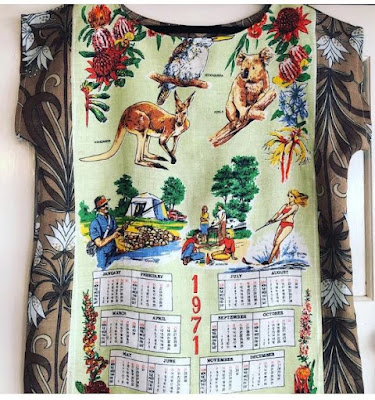
I recently ‘discovered’ (my daughter had actually been telling me to check it out for weeks!) a newish clothing and accessory shop in Wagga Wagga called Middlemost. It is named for Janene Middlemost the entrepreneur/designer/maker whose business idea it is. I wrote a piece for a local news site about her venture and designs which are deliberately eclectic and postmodern, incorporating vintage and salvaged materials, such as tea towels and furnishing fabrics not originally intended for use in clothing.They include those wonderful souvenir map and calendar style tea towels and scraps of geometric, floral and children’s designs spanning several eras.
One of Middlemost's delightful garments (image source their website https://www.middlemost.com.au/)

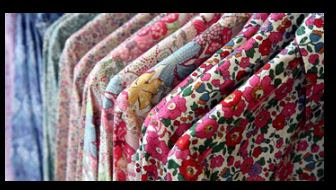
What is it about this aesthetic that appeals to me – and many others - so much? The nostalgia aspect of ‘retro’ is obvious for those of us who remember the styles of past eras, but how do we explain why people not around when ‘flower power’ and Gordon Fraser greeting cards were in their heyday still rejoice in items that use or evoke these styles? Of course good design will endure, or be rediscovered regularly. As a William Morris fan I may be biased, but I don’t think his designs have ever experienced holus bolus rejection, even in the face of staunch minimalism. Of course art nouveau and Liberty’s enjoyed a huge revival in the 1970s but they are still regularly rediscovered and introduced to new audiences. Going rural in 2014, I was surprised to discover that shirts using Liberty’s fabrics are frequently paired with moleskins by ladies of the squattocracy! 


Liberty shirts (image source http://fashiongear.fibre2fashion.com/)

The old ‘I wouldn’t hang it on my lounge room wall’ test about whether a piece of art is something you could live with has some validity when it comes to choosing the patterns and motifs we use for decor or wear. I was shocked once by a Facebook post of an affluent middle class family sitting down to dinner in front of a reproduction of Picasso’s Guernica. I didn’t think ‘wow, how edgy’ - rather I was unsettled that a work commemorating fascist atrocities could provide a back drop for the evening meal. Unless you live in MONA it is usual to want to feel a degree of comfort with your furnishing and fashions. Though personally I wouldn’t eschew all of that gallery’s holdings, Judith Lucy’s labia would be welcome on my walls! 

So what makes retro comforting? Is it possible to feel nostalgia for design trends that pre-date your existence? As a child I had a particular aversion to a teacup of my grandmother’s depicting a deep burgundy coloured rose in a hyper naturalistic lush style, a kind of Gothicised version of Royal Albert Country Roses (which I also dislike). I called it the ‘headache’ cup. Setting aside that I may have been rather neurotic, I found the motif depressing, it did not provide me with the pleasure I derived from my grandmother’s few pieces of art deco crockery with their sunny yellow, linear designs and from the cheerful fabrics mum chose for our clothes. A dress featuring golliwogs as jack-in-the box figures waving flags is embarassingly the only one preserved in a photograph.
The offending frock (author's family photo)

As the 1960s progressed, mum selected fabrics in the colourful and floral designs that characterised the decade and I happily embraced the style. She made we three sisters corduroy pinafores with tiny floral patterns in three different palettes: autumn/mauves/blues. I had a ‘twist’ dress in an emerald green striped material, with a deep ruffle around the hem that swished when I danced at birthday parties. A PVC ‘flower power’ mac with a matching hat became the most high fashion component of my pre-pubescent wardrobe (and of any other phase of my life since). I used to pray for rain so that I could wear them. I treasured my pyjama case doll with her woollen hair sprouting from a mop cap and saggy (when not stuffed with pyjamas) body of paisley fabric.

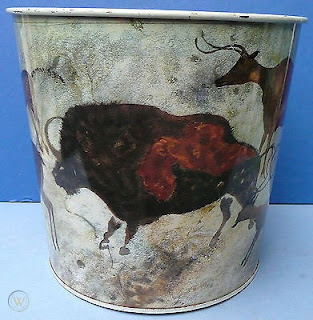
Apart from these playful aspects of 60s fashion, prehistory and Egyptology influenced our home décor. We had a wastepaper bin featuring a photographic reproduction of bison from the Lascaux caves and wallpaper in the loo depicting scantily robed female dancers and musicians based on a mural from the Tomb of Nebamun. Surely their copyright-free status was not the only attraction of these designs. 


Lascaux bison on a wastepaper bin (source https://www.worthpoint.com/). We should have hung on to it - they're collectible now!

Long before I came to understand cultural appropriation my family had place mats with Aboriginal designs on them and I baffled my teachers by using the words ‘bunyip’ and ‘dugong’ in my compositions.  I wasn’t much more enlightened in the 1980s when I copied turtle totems for a screen print design. But with hindsight the Jindyworobak movement thought 'progressive' in the 1940s, is being reassessed as naïve and even complicit in misinterpreting and exploiting Indigenous culture. 

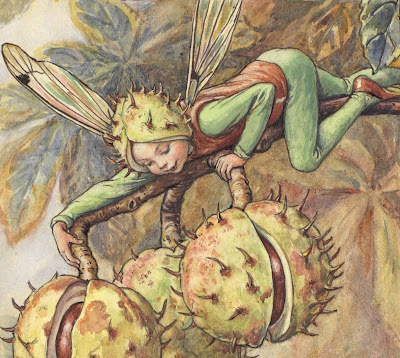
Other motifs and patterns encountered from childhood to the more recent past that continue to evoke powerful associations and, to borrow a phrase from Marie Kondo, ‘spark joy’ are Beatrix Potter’s and Molly Brett’s anthropomorphic animal characters, Cicely Mary Barker’s Flower Fairies, Arthur Rackham’s and John Tenniel’s illustrations to Alice In Wonderland, E. H. Shepherd’s to Winnie the Pooh and Harmsen van der Beek‘s to the Noddy books.
The Horse Chestnut Fairy, Flower Fairies of the Autumn, Cicely Mary Baker (source https://gardenmuseum.org.uk/)

While I was rather blasé about the Theban Necropolis–inspired wallpaper in our lavatory, I responded with awed delight at wallpaper in the bathroom of a house our family considered buying. Pink flamingos grazed for krill amongst green reeds on a black background. It was the chic-est thing I had ever seen and I wanted my parents to choose that house. But while I quite like that colour combination to this day, I wouldn’t swoon sentimentally if I saw the design reproduced now - it was hopelessly kitsch! 

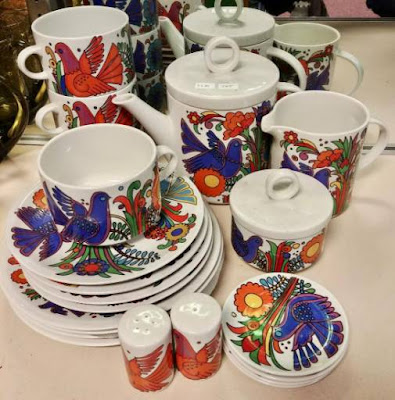
As Cole Porter observed, Whistler's mama and Inferno's Dante remain 'the top' whatever the vicissitudes of fashion! Then some things have such fond associations for us that seeing them again will always elicit feelings of comfort and joy. There seem to be ‘acquired memories’ that enter the canon too. I didn’t discover Florence Broadhurst’s designs or May Gibbs’ gumnut babies until decades after their genesis but they conjure the same reaction in me as my earlier discoveries. Sometimes, however we fail to appreciate the birth of a classic. While I have spent a small fortune collecting pieces of Midwinter’s Spanish Garden design crockery because I adored a cup and saucer in that design I owned growing up, I kick myself for not investing in a complete Villeroy and Boch‘s discontinued Acapulco dinner set in the 1980s. The rebooted version is exorbitant and inferior.
The Acapulco dinner set I wish I'd bought when it was discontinued and being sold on clearance at Prouds in the 1980s (image source https://www.liveauctioneers.com/)

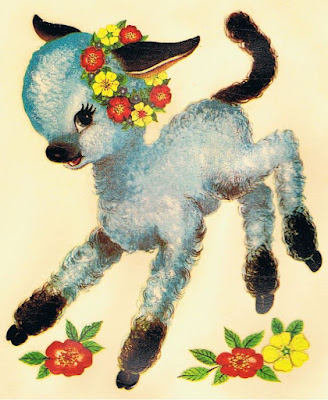
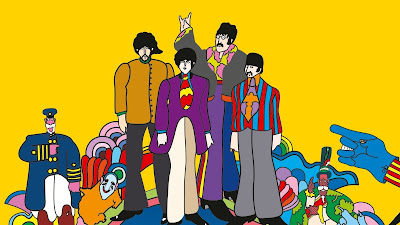
I have saved the overused ‘i’ word, iconic, unil now. For me most of the designs and images I’ve mentioned here are iconic and I would also include Ladybird and Little Golden books, the Michelin Man and Aeroplane Jelly swing girl, those Amsco decals you used to see on nursery furniture, Toulouse Lautrec’s posters and Ron Campbell’s Beatles animations. These things delight in their own right and how much greater the frisson when they are skilfully combined in a nice frock or via my own rather special interior decorating style!
Amsco nursey decal - we had a design like this on our wardrobe (image source eBay)

But does the same effect occur when the style being recaptured or celebrated precedes your own living memory? If my parents enjoyed cave paintings and Egyptian murals, which were slightly before their time, and the Victorians loved a bit of medievalism in their architecture, perhaps we can all enjoy the exoticism of past styles… Maybe a bit of morphic resonance or collective unconscious is at work as well.
An iconic image from Yellow Submarine by Ron Campbell (source https://www.vogue.fr/fashion-culture/article/how-the-beatles-yellow-submarine-colored-pop-culture)

Tuesday, December 7, 2021

Seven Year Itch?

A few weeks ago I did some rather drastic gardening, clearing out an area that was choked with weeds in an effort to access the rain water tank we’ve never used and to get a clear view of Willans Hill from our kitchen window. Something stung or pierced my right forearm that day and it has been intermittently itchy ever since. I am used to healing more slowly as I age but I still have a rough red itchy patch that hasn’t completely cleared up. I forgot to mention it to the doctor when I saw him a few days ago for our ultimate consultation (he and his partner, both GPs, are following the well-established trend of rural GPs departing for Sydney). I am wondering if a plant fibre or insect ‘bit’ has penetrated my skin. I suppose it will either work its way out over time or enter my blood stream and kill me. My great Aunt Hannah died of a bite (either redback or scorpion, depending upon which account you read) sustained while gardening in Chatswood so there is a family precedent for such a catastrophe. I am choosing to process my itch in a more metaphorical way though… 

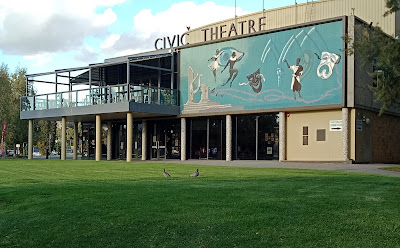
We’ve lived in Wagga Wagga for  seven years now. Could I be experiencing the itch that comes with that passage of time? In December 2015 I blogged about moving here. Rereading that post, it is positive about relocating, but it isn’t quite the paean to Wagga I remembered it as being. I remarked on ‘what I miss and what I welcome’ in my new environment, showing that, one year on, I was mindful of both. I knew the day would come when I was more familiar with Riverina people, locations and place names than I was with those I’d left behind. Although a trivia quiz at the recent  ‘Aqua Chicks’ Christmas party revealed my poor grasp of Wagga street names and of their family connections to various ‘chicks’. I had learnt about architect Steve O’Halloran’s legacy (he designed the Civic Theatre and is the father of an impressive  patrician aqua ‘chick’ who recited Mulga Bill’s Bicycle at the party).  I have researched the artistic hub that was the Wagga Wagga Teachers’ College (one of the teachers there, Lionel Gailor, entered his mural designs in the Sulman art prize competition in 1953 and students submitted the design for the podium for ER II’s 1954 visit to Wagga). The fast flowing Murrumbidgee and its gnarled sentinel gums still delight me, spreading development  means that we see fewer kangaroos than we did in our first year. I do now frequently bump into people I know when I am out something I craved I when I wrote that 2015 post. The passage of seven years, two of them without the option to travel, courtesy of COVID, has made me restless for occasional changes of scenery. A friend and I were poised to go to NYC and I had just got my first Australian passport when the pandemic hit. While writing this I have been able to make a flying visit to Sydney, which could be the subject of a complete other pluses and minuses post, but did mean I could see our son and catch up with friends.


Steve O'Halloran's Civic Theatre with some modern extensions but its wonderful mural still prominent 

Most things about the tree change have been completely positive: part-time work in a congenial atmosphere, learning how not to kill plants in this soil and climate,  walking our dog Stella in the delightful Botanic Gardens and finding joy in the Booranga writers’ and book groups. I am used to sharing the house with a few dozen daddy longlegs and will never take our view for granted. I could do without the angle of the driveway (I have meniscus tears in both my knees) and I foolishly thought a modern (1970s) house would be easier to maintain than our previous Victorian and early 20th century residences. It isn’t and we aren’t getting any younger. 

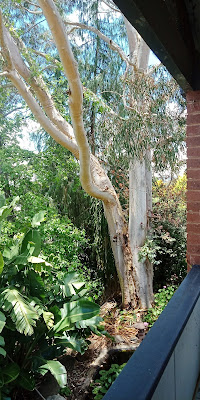
While my affection for the Riverina’s endemic gums never dims, I realise my appreciation for the enormous eucalypt in our front yard was naïve. An arborist has told us that it is not native to the Riverina but to Western Australia and suited to that dry climate. The species was chosen by local gardeners for its quick growth however its location here in a heavier rainfall region and beside our fish pond means it leaches moisture from its surrounds and has grown dangerously large, threatening to drop its substantial branches at any time. We are waiting for said arborists to make good on (i.e. not cancel at the last minute) their fourth appointment to prune the monster!


The 'monster' gum

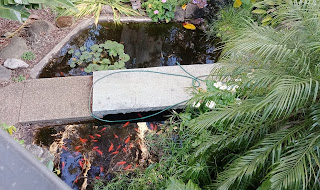
On the subject of the pond, I think I have blogged before about its maintenance requirements and how two goldfish have spawned a clan of over forty! The sight of those swirling  tangerine shoals and of little fish mouths piercing the water’s surface begging for  pellets has its own aesthetic but the banjo frogs that used to serenade us each evening have been silenced. I have seen the piscine ruffians scoffing frogspawn and even tearing apart a live frog. I am now trying to figure out a way to restore the native pond life. I’m going to ring the zoo and see if they want some gold fish – I have given away dozens in the past.


 Our fish pond - topping up the water level and and about to feed the ravenous occupants

In other aquatic news, there is now, again COVID instigated, a ceiling on numbers for aquarobics classes and I am seldom quick enough to secure a spot so my established regime is disrupted. I have bought an exercise bike but it has not won my allegiance in quite the same way. It will soon be hot enough to choreograph my own routines in our (unheated) pool, in the meantime I need to ‘get on me bike’ and generally think laterally about alternative forms of exercise. 

That is if I don’t succumb to great Aunt Hannah’s fate!

Balm for the soul (and the itch) - Wagga's Botanic Gardens

Note: all my photos.

Friday, September 3, 2021

Voluptuous Antiquity in Turvey Park

Myrtle[1] is the name of a life sized nineteenth century bronze statue that stands in a non-descript area of Charles Sturt University’s Wagga Wagga campus. She is not the first nineteenth century female bronze I have encountered since moving to Wagga in 2014. That was a spelter art nouveau dancer discovered in an even more unexpected location, amidst car parts and man cave accessories at the Wagga Wagga Swap Meet!  We needed something to populate the plaster niche in our eclectic new home and I am a long standing fan of art nouveau. She was perfect, reasonably priced, and came home to our niche where she has been ever since.

The dancer and some other art nouveau-esque pieces in our niche (my photo 2021)

Myrtle we encountered not long afterwards. She is not art nouveau, more classical, clad in drapey robes, one breast bared, holding aloft a torch and clutching a botanical specimen in her right hand. Her exact location is beside the Tabbita Walk on CSU’s north campus close to a student accommodation block and a pair of dumpsters. She is perched upon a metal plinth significantly eroded at one corner by dog urine and a plaque on her base proclaims in a stylised font that would threaten to upstage her were it not so tarnished: 

Myrtle

Carrier–Belleuse, France

Donated to Wagga Wagga Teachers College

by

the Wagga Wagga Chamber of Commerce in 1954

she graced the lawn in front of the

Principal’s Office next to a large crepe myrtle bush - hence her name

 
The plaque (my photo 2021)

Myrtle and a glimpse of  the dumpsters (my photo 2021)

While it was serendipitous to find the only art nouveau objet d’art at the Wagga Swap Meet, it was downright puzzling to find a statue by acclaimed  nineteenth century French sculptor, Albert-Ernest Carrier-Belleuse (1824 - 1887) in the middle of CSU’s expansive campus in the company of those dumpsters and approximately 100 metres away from a lonely unused bandstand. It was the bandstand that led me to Myrtle. My obsession with rotundas and bandstands dates back to my childhood playing in a neglected one in Valentine’s Park, Ilford, Essex (see my blog post Strike Up the Band Once More). It turns out that Myrtle and the bandstand have some shared provenance, but that is for another post. 

The man who created Myrtle, Albert-Ernest Carrier-Belleuse,  had a highly successful career in France and Britain producing major works like his marble La Bacchante (1863), purchased by Emperor Napoleon III for the Jardins des Tuileries, and his portraits of cultural icons Rembrandt (1880) and Dumas (c.1883-87) as well as creating prototypes for multiple castings, usually on allegorical or mythological themes, for manufacture by British companies Minton and Wedgwood. His works are in the Metropolitan Museum of Modern Art in the USA, the San Martín Cathedral in  Buenos Aires and in our own National Gallery.

How, I wondered did one of his sculptures come to be gifted to Wagga Wagga Teachers’ College in 1954? How did that statue then wind up on the campus of Charles Sturt University? Pondering these questions led me to speculation, trawling TROVE, posting an enquiry on Facebook, and, ultimately, to the research findings of CSU archivist Jillian Kohlhagen and CSU art curator Dr Tom Middlemost. Here is what I discovered. 

As the plaque states, Myrtle was acquired on behalf of the thriving local Teachers’ College in 1954. Her purchase was announced in The Daily Advertiser of 29 April 1954[2] as follows: 

The Wagga Teachers’ college were granted a £25 donation and an interest free loan of £75 to cover the cost and erection of bronze statuary outside the college. The statuary is by well-known Australian (sic) sculptor A. Carrier. The college plans to illuminate the statue and install a plaque at the base. 

Unless The Advertiser was mistaken about the purchase arrangements as well as the sculptor’s nationality, it appears that initially at least Myrtle was not an outright gift. Maybe the Chamber of Commerce waived the debt later. Other editions of The Advertiser from the period reveal that Myrtle was joining an impressive art collection the college was amassing. However, she is stylistically at odds with the modernist flavour of the college’s other acquisitions.  In its catalogue of artists featured in their collection,[3] the National Gallery of Australia dubs Carrier-Belleuse’s style ‘voluptuous antiquity’, an apt description of Myrtle given her classical garb, sinuous lines and semi-nudity. Other pieces the college bought or was gifted during the 1950s include a watercolour and 3 lithographs by Frank Hinder, a series of pen and wash drawings by Roy Delgarno[4] and 12 oils by Herbert Gallop.[5] Hinder is an abstractionist, Delgarno, a social realist and Gallop produced landscapes that evoke the Heidelberg school but also the travel poster and pub art of the 1940s.


 Myrtle in situ in the formal gardens in front of the administration block, (Source: CSU Archives)

Myrtle is signed ‘A. Carrier’, like all  his pre-1864 pieces, so she likely dates from the 1850s which means she was perhaps 100 years old or more when she came to reside in Wagga. Was she found in a local antique shop? If she came from Sydney or Melbourne, how, in those pre-internet days, did her availability become known to Riverina customers?  What influenced the college’s choice? Was it her European artistic pedigree or her allegorical qualities? Did her lantern–bearing pose suggest the illumination provided by a place of learning? Was she just an attractive bargain? Once installed on her concrete plinth in the college gardens, amongst rose and myrtle bushes (‘hence her name’), her attractiveness to some of the students became apparent.  As archivist Jillian Kohlhagen puts it ‘certain students… took to polishing her exposed anatomy’. Or to quote a graduate of the college, Mavis Lupton, reminiscing about her student days in the Lost Wagga Wagga Facebook group, ‘In 1962 – 63 - I remember some of the boys polished Myrtle’s exposed breast’. [6] 

The Wagga Wagga Teachers’ College was established in 1947 to meet a state-wide post-war need for teachers. It wasn’t the first Teachers’ College in Wagga – there had been a more modest one on Copland’s ‘Hillside’ Estate on Willans Hill founded in 1928[7] The new college was almost built on part of the showground, but a former RAAF hospital site in the nearby suburb of Turvey Park won out. It was the first wholly residential co-educational tertiary institution in Australia and early intakes included ex-military and mature aged students. The campus buildings were linked by intersecting covered walkways and set amongst impressive grounds conceived by the Chief Landscape Gardener of the Department of Agriculture , Ezra Steenbohm and realised  by Lucas Schatte, described in The Advertiser[8] as ‘former Royal gardener to King Peter of Yugoslavia’. The college’s tiered and trellised ‘Pleasance’ incorporated an ornamental fishpond and another bronze, a miniature Naied, by contemporary English sculptor Katherine Murray-Jardine. Its whereabouts today can only be guessed at.  Maybe I will happen upon it in my wanderings.


Female students beside the fishpond and the miniature Naied
 in the Pleasance (Source: The Wagga Advertiser, 8 October 1954)

The Teachers’ College closed in 1971 and became part of the Riverina College of Advanced Education which then merged with CSU in 1986. The old college buildings and grounds have long since fallen into disuse and there is no trace of any rose or myrtle bushes on the site. The CSU Archives now house the college’s art collection in a Brutalist-style building at the old college location shared with the Riverina Conservatorium. In the past two years a new housing estate has sprung up adjacent to the old campus.  In 2018 it was announced that the Conservatorium is destined for new accommodation on Simmons Street beside the Wollundry Lagoon. I am not sure where the Archives are headed but as the H.R Gallop Gallery is already situated on the CSU campus I suppose they may be joining it. 

In the 1950s and 60s Myrtle stood, an idealised beauty, serene and impassive, shining her lamp over manicured gardens and enduring the irreverent, if affectionate, attentions of young male students. However, she vanished from the grounds some ten years before the college closed. Sad students wreathed her empty plinth with flowers and left a poignant sign there lamenting her disappearance. Rumour has it that the Principal, Maurice Hale, thought the constant attention to her anatomy was ruining the statue’s patina and another, associated, theory was that the sun reflecting on her polished surface, shone directly into his office[9].  She went to ground until she was re-erected in her present location. 

Dr Tom Middlemost, CSU’s Art Curator, has delved into her origins and discovered that Myrtle is in fact one of a pair of bronze ‘torchere-holders’, originally designed to support gilded candelabra, representing Night and Day.[10] Myrtle, whose head is draped and who holds sleep-inducing poppies in her right hand, is Night, her companion Day is bareheaded and with braided hair[11]. Carrier-Belleuse produced numerous similar figures throughout his life, usually as adornments to grand public buildings. It seems safe to assume no others found their way to a rural Australian university.


One of the three Lionel Gailor murals entered in the Sulman art prize competition in 1953
 (Source: The Wagga Wagga Advertiser 5 March 1953) 

I am still intrigued to know what drove the Chamber of Commerce and the Teachers’ College to select Night/Myrtle for her place of prominence on the campus and wonder if the burnishment she endured at student hands might not have been predicted.  Her whereabouts during her temporary retirement would also be interesting to discover. I am, however, very glad she’s back on view and we know a little more about her history. Now to investigate the fate of Murray-Jardine’s small bronze Naied and of the three Lionel Gailor murals [12]depicting the progress of the Wagga district, the history of education, the life of the college[13] that once adorned the college’s Assembly Hall and were considered worthy of entry into the Sulman prize art competition. Oh, and to find out more about the bandstand of course. 

NOTE: Much of this information came from Jillian Kohlhagen's excellent CSU Archive blog post For the Love of Myrtle and from a conversation with Dr Tom Middlemost. Those sources are acknowledged and I extend my thanks to both of them.

[1] Not her real name, read on...

[2] ‘Pleasant Corner of College’ The Daily Advertiser 4 March 1953

[4] ‘Art Collection Being Built Up In Wagga’ The Daily Advertiser 5 May 1950

[5] ‘Oil Painting At College’, The Daily Advertiser 7 October 1954

[6] Lost Wagga Wagga Facebook group 25 August 2021

[7] Sherry  Morris, Wagga Wagga - A History, Bobby Graham Publishers, 1999

[8] 'Happy At Wagga', The Daily Advertiser 4 March 1953

[9] ‘South Campus – A History’ by Dr Nancy Blacklow quoted in CSU Archive blog post ‘For the Love of Myrtle’ 25 August 2019

[10] Information provided by Jillian Kohlhagen in a response in comments to her blog post ‘For the Love of Myrtle’ 25 August 2019 

[11] https://toboganantiques.com/en/objets/carrier-belleuse-colin-torcheres/

[12] ‘Wagga College Murals Entered For Big Art Prize’ The Daily Advertiser 5 March 1953


Sunday, July 4, 2021

Wagga's former commercial glories

Time was when most country towns had a local department store, usually a family owned business that had grown to meet the community’s consumer needs. These days Knights and Hunters on the Hill seem to be the only extant home grown retailers. Both businesses are now shadows of their former selves.  A bit of research proves that Wagga once had many more thriving local businesses.  The Museum of the Riverina did more than a bit of research to produce their recent pair of exhibitions: Huthwaite’s the Friendly Store and Made in Wagga.


Huthwaites in the 1960s (photo source: Lost Wagga Wagga Facebook Group page)

The latter is a recreation of the an exhibition from 1999, the year the City Council took over the running of the museum from the local historical society. Made in Wagga comprises stories and artefacts from Wagga’s history, identities, industries and businesses that showcase the once vibrant and thriving commercial culture of the city.

Amongst the industries and entrepreneurs featured are:

  •          Milliner Marea Bright whose business still exists and has provided stylish hats  for Wagga’s bridal parties and race goers for over 50 years.
  •          Charles ‘Bartle’ Nixon who began in 1858 selling watermelons to bullockies to producing a successful range of condiments in a business that lasted until the early 20th century.


Information about Wagga's condiment king from the exhibition - my photo

  •          August Menneke, a German immigrant who forged cattle bells from imported steel at his foundry in North Wagga in the 1860s and 70s. His business features in the writings of Alan Marshall and Mary Gilmore.
  •          Bendigo boiler maker, Gerard McEnroe, inventor of the Chiko Roll, which made its debut at the Wagga Wagga Agricultural show in 1951

Something of a surprise amongst all the commercial and industrial exhibits is Maure Kramer’s 1976 prize winning Crabcycle Gumi boat (revived for the 2004 race). However it certainly fits the description ‘made in Wagga’ and its presence adds to the general diversity and nostalgia of the exhibition.


Crabcycle Gumi boat - my photo

The highlight of these two-exhibitions-in-one was the presentation of the history of Huthwaite’s department store. The collection of items, imagery and reminiscences about  the store which operated in Wagga for 75 years, is rich and varied. It included informative audio visual presentations and a wealth of photographs and objects including a delivery bicycle and original carrier bags and advertising material.


Huthwaites delivery bicycle - my photo 

One shortcoming of the exhibition was the lack of information provided about the content of the two videos – when I visited I had to ask a staff member a number of questions about who was speaking/ being interviewed.  The staff, as they always are, were very helpful and I have since discovered that a number of fact sheets relating to the Museum’s collection, including these two exhibitions, is available online: https://museumriverina.com.au/education/schools/facts-sheets


The Museum of the Riverina has two locations - these exhibitions were at the old Council Chambers site on Baylis Street (photo source: https://threebestrated.com.au/landmarks-in-wagga-wagga-nsw)

Monday, May 17, 2021

Abundant Wonder – Tom Moore

National Glass Gallery, Wagga Wagga, NSW 

Tom Moore is one of Australia’s pre-eminent glass artists, and probably our most innovative. His retrospective exhibition, Abundant Wonder, currently showing at the National Glass Gallery, Wagga Wagga is a cornucopia of sinuous, whimsical objects showcasing  this talented artist at the peak of his powers.

This touring exhibition, commissioned by Adelaide’s Jam Factory in 2020, is the culmination of over 20 years practice and features hundreds of individual and tableau-style pieces.  It is a  technical tour de force that is also visually enchanting and provoking, humorous and disturbing. 

In a 2016 interview Moore said that his work is ‘trying to make sense of a complicated and nonsensical world’.  In doing so he repeatedly returns to the theme of  ‘human-initiated environmental damage’  through mutant figures, half machine, half animal, lush vegetable forms sprouting eyes, potato-like disembodied heads in a cabinet of curiosities and sea creatures out of their element. 

Despite their apparent organic spontaneity Moore’s objects are based on detailed drawings and are wrought through highly challenging techniques. The artist and commentators have noted the paradox of creating objects of such writhing vitality out of the rigidity of cooled glass.  Moore’s inspiration is eclectic, there is a clear evocation of pop art, think the Beatles’  'Yellow Submarine',  Reg Mombasa’s  Mambo imagery, Nickelodeon’s 'Real Monsters', Tim Burton... Two avowed influences are the drawings of nonsense poet, Edward Lear and the capriccio glass vessels of 13thC Venice.

Many of Moore’s creations are distinctly Australian in their inspiration, kangaroos with other kangaroos as heads, both roos and koalas emblazoned with lit matches, a semitrailer carrying a hammerhead shark. Re-imagined dinosaurs feature prominently too, many with tiny appended wheels that would buckle under  their ‘real life’ weight.   More playfulness with his materials! Every fabrication is simultaneously both delightfully amusing and expressive of  his deeper concern for the planet under threat.


The  theatricality and dynamic qualities of Moore’s work makes it ripe for  animation and a major component of the exhibition is the digitally created videos depicting his hybrid creatures in fantasy landscapes blinking, flying,  spinning, consuming one another and even exploding – his favourite effect! 

All this richness  and grotesquery is displayed  in the reassuringly familiar setting of cubby houses and puppet show  booths, storybook illustrations and  alphabet blocks. Thus we are soothed and beguiled only to be confronted and disturbed.

Do see Abundant Wonder. It is in Wagga Wagga until 4 July then travelling to Victoria, Queensland and South Australia. For details visit: https://www.mooreismore.com/abundant-wonder-exhibition-and-tour/