Thursday, September 3, 2015

Cigar Smoke in the Billiard Room


My husband remembers his (great) Uncle Bill’s place at Glebe Point from the 1950s when, aged four or five, his mum at work and in his grandfather’s charge, they would drive in the FJ Holden down from Johnston Street, Annandale past warehouses and factories along the edge of White Bay. They crossed a wooden bridge over Cook’s Creek and entered number two Forsyth Street via a worn, uneven brick and stone paved drive that spanned 20ft of the the property’s vast width. The driveway  rose gently towards the back of the house leading to an old barn and stables now serving as  a garage and workshop and housing a makeshift office  where Pop sat to do the accounts for  Treharne’s Taxi Service.  The roll top desk Pop used was big enough for a child to hide in and whenever my husband sees His Girl Friday he recalls squeezing between its pigeon holes, tiny drawers, secret compartments and the wooden roller shutter.

To keep him occupied while he did the books, Pop would give his grandson a pencil and a little cloth bound notebook with marbled covers in which he would pretend to write. The ‘office’ smelt of the oil and grease that wafted from the workshop and of dust and old leather. Beside the desk was an old fashioned standing phone, its separate earpiece dangling at its side.

At lunch time they walked down to the huge two storey house. Sometimes they entered at the rear through a service wing with kitchen, laundry and storerooms separated from the house’s living rooms by a hallway.  Sometimes they entered from the front, passing a gravel drive that encircled an Italianate fountain featuring a nude female form and cherubs. They climbed three broad steps to a veranda that afforded views of Blackwattle Bay, Wentworth Park and the city and entered through a wide doorway. Inside a vestibule led to a marble staircase that took you to the six bedrooms on the upper storey. It was flanked by two enormous rooms with shuttered French doors and ornate fireplaces.  The ground floor was redolent with the smoke of Cuban cigars which Uncle Bill drew from an abundant store of exotically decorated wooden boxes.

In 1971, my husband was driving trucks for white goods manufacturer Malleys and made a delivery of refrigerators to Forsyth Street, Glebe. He was surprised to discover that they were destined for a brand new block of flats called ‘Arden’ on the site of his great uncle’s former residence and place of business. A few years later when we lived in Forest Lodge diagonally opposite the old Nag’s Head and I crossed the footbridge each day to uni, he told me about the ‘mansion’ up at Glebe Point that had once been in the family. Impecunious and lovers of Glebe’s old architecture, we felt wistful that any money the family once had was now long gone and that the grand house no longer stood.


Business card for Treharne’s taxi depot and repair workshop circa 1960.

It wasn’t until the genealogy bug bit me this century and I started researching the Treharnes of South Wales, who emigrated to New South Wales, living first in  Newcastle and then in and around Sydney’s west,  that I learned more about Uncle Bill, or William Maritime Treharne to give him his full name. I came to wonder how a sickly youth from Stanmore  had become a shrewd businessman who owned a shop at 369 Glebe Point Road and  a holiday cottage at Lake Conjola as well as the Forsyth Street property my husband remembered. I became particularly curious about 'Arden' itself and how what was clearly once a gracious residence, became a taxi depot and then fell to the wrecker’s ball.

Although today Arden is a block of flats, a glimpse of its former incarnation is possible via an online tool called SIX maps which allows users to switch between modern day Google maps-type imagery of Sydney and suburbs and a grainy 1943 black and white aerial survey of the same locations.  On SIX maps I found the fuzzy outline of the house William Treharne had owned for 50 years.  My husband recognised the shape of the grounds and could show me where the stables/office were. From then the quest was on to find a better image of Arden and to learn all I could about its history.


The two dwellings George Miller built at Glebe Point in 1836-37 as they looked in an aerial photograph taken in 1943.

As usual, I turned to TROVE, the National Library of Australia’s database of scanned newspapers, searched for ‘Arden Glebe Point ‘ and found numerous references to it as a Church of England Girls ‘Rescue’ Home in the era directly before William Treharne first leased and then bought it in 1929. By Googling the same terms I even found a copy of the original lease agreement between the church and Uncle Bill! A ‘rescue’ home was an institution where ‘fallen’ women could be redeemed and rehabilitated. The Glebe homes (they comprised four buildings) also catered to children whose families were unable to care for them and later, as ‘Hammond Hotels’, to entire impoverished families. Arden was the last of four buildings in Forsyth Street acquired by the church for this purpose and served as the administrative office for the homes. The others were Strathmore (built in 1857), the grand former home of Sydney businessman and politician Alexander McArthur, Tress Manning, purpose built as an institution in 1909, and Avona about which I was soon to learn more.

In 1928 the girls' home relocated to Carlingford leaving Arden and Avona vacant. William and his wife Ivy were living above the Glebe Point Road shop at the time just across the laneway from Arden. This must have seemed a perfect opportunity to extend the business and gain more spacious living arrangements.  From the newspapers it looks as if they bided their time while the church tried unsuccessfully to divest itself of a white elephant, entered into a lease arrangement and probably eventually bought the house for a song. The couple’s two sons must have been born at Arden; I am still following their trails and hope to uncover some recollections and photographs of their years at Glebe Point. There is a certain electrical contractor at Lake Munmoorah who may be Uncle Bill's great grandson.


The block of flats named ‘Arden’ which now stands at 2 Forsyth Street, Glebe.

We knew that Uncle Bill retired to Sans Souci in 1971 and that Arden was sold to developers and demolished the same year, now I  worked backwards to discover who had lived there earlier and who built the house.  The Glebe Society has an occasional series of articles in its newsletter called ‘Who Lived In Your Street?’ In 2009 they ran one mentioning that a Dr Rudolph Bohrsmann and family lived at Arden from 1907 until the church acquired it in 1918 and that he had in turn purchased the house from wool merchant Eugene Carette.  

I now had two new names to search on and gradually established the sequence of owners and residents at 2 Forsyth Street. A breakthrough came when I realised that it was the Carettes who named the house ‘Arden’ and that previous mentions of the property referred to it as 'Forsyth Cottage' and the land it occupied as the Forsyth Estate.  Searching by ‘Forsyth’ I found ‘To Let’ advertisements where the contact was a Mr George Miller of Forsyth Cottage; these led me to believe that the house was frequently rented out yet this didn’t tally with birth announcements for the Miller family at the cottage. In the classified advertisements the house was described and my husband said it didn’t match his recollection of Arden’s layout; he couldn’t see how it could ever have included a croquet lawn and a rose garden. It turned out that the discrepancy was because these advertisements weren’t looking for tenants for Forsyth Cottage at all, but for a neighbouring property!

A bit more research and I made the happy discovery that in 1836 - 37 two dwellings were built on newly released land at Glebe Point overlooking Blackwattle Bay by a Mr George Miller (source: City of Sydney, History of Sydney Streets) I found bits and pieces about George Miller on TROVE but I wasn’t sure all the references were to the same man until the Manly Library Local Studies Blog joined the dots for me in a post entitled ‘Who was Sarah Ann Miller?’ . Well, she was George Miller's wife then, for many years, his widow. The post also revealed that Miller was a Scot who who arrived in Australia in 1822. He worked for the Commissariat Department (army and navy stores) for nine years, posted first to Port Macquarie and then to Melville Island. The work was gruelling and took a toll on his health so he returned to Sydney to follow the less physically taxing profession of banking.  Between the late 1830s and the 1850s he rose from clerk, to Director to Manager of the Sydney Savings Bank and was dubbed the ‘oracle in colonial banking’.

Miller built Forsyth Cottage as a home for himself and his new bride Sarah Bailey (widow of a fellow Commissariat employee) and built a second, grander residence nearby called Avon House/Lodge (later ‘Avona’). It was Avona that he regularly advertised as ‘to let’ in the newspapers in the 1840s and which boasted the rose garden and croquet lawn.


Auction flyer featuring an artist’s impression of Avona and subdivision plans for its estate 1899 (NLA).

Sarah and  George had  a large family at Forsyth Cottage, and in  1855 Miller applied for two years’ leave of absence and the whole family took a trip to Scotland where he died suddenly in August 1855 aged only 55 years. Sarah, widowed for a second time, returned to Sydney to await the granting of probate, leasing out their Glebe home in the meantime.  Between 1856 and 1858 engineer William Randle, responsible for constructing parts of the Glebe Island abattoirs, the Great Southern Railway and much more of the Sydney rail network besides, lived at Forsyth Cottage.

In 1860 the house was put on market and fetched £2000.  By 1863 it had been renamed 'Arden' and become home to the Carette family.  Eugene Carette,  a Frenchman, was a successful wool buyer who lived and worked in Adelaide and Britain as well as NSW. He had a large family, three members of which were born at Arden, two daughters and a son in 1897, 1898 and 1900 respectively. The Carettes quit Arden in 1901 departing for France and selling off all their household furniture and effects at an onsite auction. Also listed for sale was a pair of bay horses and a ‘Superior Victoria carriage’ – all occupants of what became the Treharne ‘office’ space.  Poor Eugene Carette died in what must have been one of Paris’s earliest motor vehicle accidents in Paris in 1926  and his obituary in The Register of Adelaide stated that he left numerous children and that ‘several of his sons’ worked in the family business.  

Details about other occupants of Arden remain sketchy. Export agent George Munro, lived there from about  1888;   he and Mrs Munro hosted a lavish wedding reception for their daughter Ida there in 1894. Refreshments were served in one of those large downstairs rooms which was described as the 'billiard  room'.

Finding a picture of Forsyth Cottage/Arden remained a challenge. Leichhardt Library holds surveyor’s drawings of the Avona and Forsyth estates only some of which are available online and the State Library of NSW has a Glebe subdivision plan that mentions the Arden Estate. What level of detail these documents hold will only be revealed when I can get to  Sydney to view them. On a genealogy site I found and contacted descendants of the Millers (who knew nothing about Forsyth Cottage) and of the Bohrsmanns  (who have yet to respond but who have  attached to their family tree a tantalising photograph of Dr Rudolph playing backyard cricket in what just might be the grounds of Arden). 

Through TROVE I knew that the Church of England homes often held meetings at Arden and had a couple of fetes in its grounds.  After much searching, TROVE also yielded up, in the Friday 11th May 1928 edition of the Sydney Morning Herald, under the snappy headline ‘C. OF E. GIRLS' HOMES AT GLEBE POINT, FOR THE TRANSFER OF WHICH TO CARLINGFORD AN APPEAL HAS BEEN LAUNCHED’ this photograph. 

 Eureka! Maybe not its best angle - it's the service wing - but perhaps the only photograph of Arden in existence, taken in the house’s last year as part of the girls’ home complex (SMH May 1928).

The photo shows the rear of a house, the girls and staff congregated around the back steps, a picket fence and washing on a line.  It’s location at ’some distance from the main buildings’ and my husband’s memories confirmed it – it is Arden - as it looked shortly before his great uncle moved in!

STOP PRESS:
Through further digging in TROVE I have uncovered 2 more gems. The first is that Forsyth Cottage was indeeed a cottage until 1879 when the Carettes added the second storey, and made other renovations.  The second was an advertisement from July 1929 placed by the Church of England who were attempting to sell Arden as 'a subdivision opportunity' (it was passed in at auction). It contains a full description of the property which reveals that the Carette's additions included that marble staircase as well as a ballroom and conservatory! I reproduce the cutting here.


Notes
A potted history of the homes appears on the Glebe Society’s website: http://www.glebesociety.org.au/wordpress/?socialhistory=glebe-care-homes-for-children

The Manly Local Studies post can be read here: http://manlylocalstudies.blogspot.com.au/2013/05/who-was-sarah-anne-miller.html

STOP PRESS: Went to the Mitchell Library recently and searched loads of maps and real estate fliers of the Forsyth and neighbouring estates. Below is what is known as a cadastral map showing the outline of Arden. 


Sunday, August 16, 2015

Women In The Shadows


I posted a while ago about how I have become hooked on family history.  I continue to make discoveries both great and small: finding  an envelope in an old box of photographs containing three pages of reminiscences written in a shaky hand by my grandmother recalling her early life in Newtown, tracking down through birth announcements, school records and newspaper stories that my second cousin once removed was a champion footballer who won three ‘best and fairest’ player medals and had a Prussian  army captain for a grandfather, learning that one of my great grand aunts became the  single mother of two young girls quite unceremoniously when her husband was arrested for producing and passing forged £1.00 notes and deported to Noumea.


It seems possible that my paternal line is traceable back to Switzerland in 1200 AD, but investigating that is just too mind boggling given that I am challenged enough fleshing out the past four generations in Australia! With the help of a first and a second cousin and various databases, I have been able to piece together quite a lot of my family members’ lives and stories.  Now that I have ‘gone bush’ I can’t easily visit the record repositories, museums and cemeteries that are the haunt of ‘genies’ but it is amazing how much is available online and it is heart-warming how generous other family history buffs  and volunteers at local historical societies can be.  I am as excited now at the arrival of a package of photocopies of documents and pictures as I used to be at the arrival of bric-a-brac I had bought on eBay!

But I have to remark on one complication that hampers my research.  I kept my so-called maiden name i.e. the surname I was born with, both for ideological and practical reasons, when I married back in the 80s.  I had not been bitten by the genealogy bug back then and it never occurred to me that continuity of identity had implications beyond feminist principles and avoiding the mess of changing bank accounts, electoral roll listings etc.  It wasn’t until I saw Armandine Garnay disappear to be replaced by Mrs R. L. Thornber and Regina Louise Pittard morph first into Mrs Charles Norett, re-emerge temporarily as Mrs Regina Norett (widow), only to be subsumed by the moniker Mrs J. B. Wallis (one of three succeeding women to be known by that name) and then to surface briefly as Mrs R.L. Wallis (widow) in the last few years of her life, that I realised how difficult the custom of assuming one’s husband’s name makes family research.  Add to this non-standardised spelling, 'Noirette' for 'Norett' and 'Wallace' for 'Wallis', and it can take a lot of detective work and guesswork to track down female relatives.

Another challenge is what the papers considered newsworthy in past eras. Business ventures and sporting achievements often got a mention so I stumbled upon (male) entrepreneurs, cricketers and footballers in the family quite quickly.  Female golfers and bowls players occasionally made it into the papers’ columns but a single initial and surname are hard to verify as the particular ancestor you’re seeking.  Marriages, births and deaths, assuming the family had the price and presence of mind to post a notice, can be depended upon to an extent. The first two usually reveal the bride’s/mother’s former identity. I remember the first time I heard the term ‘nee’ referring to a woman’s surname prior to marriage. It was on the saucy sit com ‘George and Mildred’ when Mildred was referred to as Mildred Roper (nee Trembler). Boom tish!  Incidentally, the Newcastle region leads the pack in their enthusiasm for printing wedding photographs, their local papers, in my experience,  had by far the richest source of blurry black and white pictures of newly hitched couples back in the 1940s and 50s.

Unless they moved in exalted social circles (none of my forebears really did) or were conspicuously active in the Country Women’s Association (Armandine Thornber nee Garnay was forever demonstrating her spinning or judging at rural shows) not many women featured in the newspapers. Of course women who held  important positions as matrons or headmistresses got some coverage, but shopkeepers, seamstresses, laundresses and those discharging ‘home duties’ (the term the census  used)  like my lot, only featured in the paper if they took out a classified ad selling a pony or a sewing machine.  Nowadays the likes of the Trading Post online and Gumtree and the explosion of social media have made both ‘For Sale’ notices and wedding coverage in newspapers redundant, but they helped to bulk up copy until about the 1980s.

My great grandmother was selling a pony and sulky in 1912.


So large chunks of women’s lives were not revealed in the media and, to my frustration, my female antecedents go ‘off the radar’ for years at a time especially if they weren’t reproducing during that period. Like the veiled mothers in Victorian photographs you may sense their outlines behind their more prominent offspring. Later their attire at their progenies' weddings might attract a few words in a newspaper but not for them election as aldermen, retirement send offs or visits to court to recoup debts or declare bankruptcy.  Even the ratio of industrial accidents and driving offences is firmly weighted along gender lines. While male relatives have had trees fall on them at work, lost fingers on the production line, been pulled over for faulty headlights or charged with indecent language, I have only been able to trace one female in our tree being fined for driving under the influence and she is only a relative by marriage!


A Victorian 'hidden mother' photograph  - she's there to keep the children from wriggling  but why disguise her?


Thank goodness for Trove (the National Library’s collection database) I have discovered so much trawling through it.  Some of my ancestors got more than their 15 minutes of fame – if they served their country, opened a successful emporium or played a pretty classy game of football – but the women got disproportionate obscurity, some not even accorded their own ‘real’ names in their death notices.   My greatest satisfaction and ongoing quest is to talk to those family members still around today who can throw a light on the shadows they inhabit.

Monday, April 6, 2015

Eight legs bad?

“And God made the beasts of the earth according to their kinds and the marsupials of the bush according to their kinds, and everything that creeps, slithers and scurries upon the ground according to their kinds, and even the sneaky cats who pounce on anything that creeps, slithers or scurries according to their kinds. Not to mention any number of things that bite, sting, build webby structures to ensnare the unwary or just look really menacing according to their kinds. And God can’t seriously have seen that it was good. At the very least he must have admitted that his creation was a bit fraught with moral dilemmas, I mean, really, was he having a laugh or what?” (Genesis 1: 25 – paraphrased). 

So it’s month seven in the antipodean garden of Eden that is Wagga Wagga, New South Wales! I would like to say that the body count had stabilised at minus two rabbits and one cat but although the latest casualties have not come from amongst the ranks of our pets the carnage goes on.  I have lost count of the variety of dead things, or bits thereof, I have seen.


John Percival's 1951 image of an Australian Garden of Eden (just like Wagga Wagga but without spiders)


Portents were here from the beginning had I but heeded them. There was a cow skull attached to the aviary when we arrived, we've found a wombat skull and several other skeletal remains strewn about in the bushland behind our house. The roads on the journey to Wagga featured plenty of the grey/pink sludge that speaks of ex foxes, rabbits, 'roos and possums.  Death was and  is omnipresent.  


Local skulls 

Notwithstanding the Christian reference I began with, I am now going to go all Hindu and suggest that the demise of any living thing could be viewed as diminishing us all. As a nature lover I have always thought along those lines. However, in later life I am having to harden the hell up! Otherwise I would be in perpetual mourning.

Some deaths come from the indifference of nature like the freak storm one afternoon that brought the temperature plummeting by about twenty degrees and saw off our koi carp, or the strong winds that dislodge the odd nest of fledglings. These deaths I can view as sad but unavoidable.

Many more deaths though are the result of human impact (and here the guilt starts to seep in). The trappings of civilisation we invaders have brought to the bush like the chlorinated pool water that defeated a naive little frog and the swift, convenient vehicles that plough into nocturnal animals. Then there are the expired skinks and small birds that have met their ends courtesy of our supposedly ‘indoor’ rescue cats.

However my own deep, personal shame is that I am now an agent of death -  I regularly commit arachnicide! Is it the thin edge of the wedge? Will it be long before I join the Hunters and Fishers party?

My metropolitan philosophy had ever been to gently evict any creepy crawly that attempted to share our living space, this is how I came to justify a more drastic solution.

For weeks there lurked in the crevices of the rocks around the pool an abundance of spider types. At least a third of them were red backs and although I was assured that their fangs cannot pierce human, canine or feline skin I let my fear and repugnance get the better of me. Soon I was using insecticide, water jets and the base of a thong to despatch them. These weapons (apart from the thongs) knew no nice distinctions and many harmless grass spiders met premature ends in the purge.


Pool (and everywhere else) lounger  

Then there was huntsman season. Something just snapped when my 3 a.m. lunges with upturned Tupperware at the biggest bloody huntsman I've ever seen on the pelmet in my daughter’s room proved completely useless and the monster just scurried about menacingly.  I  protested not one jot when my son tried to ‘take out’ the spider in a more final way than I had planned. He used the plastic wrapped rolled Herald like a kind of javelin/snooker cue hybrid and thrust it at the creature. The spider retreated  between the slats of the blinds and I found one of its legs, though not the rest of it, on the window sill the next day. Within a week its relations were all over the joint and we became quite blasé about removing them with no care for their well-being. Next the humble daddy long legs fell victim to my callousness. So abundant and prolific are they that you can denude a room  of them one day and find five or six in residence again the next.


A simulation of the huntsman on the bedroom wall scenario 
although this one is MUCH smaller!

In fact it is a Waggan thing that spiders and their webs simply abound! The eaves and window frames of every building, the wheels, doors and wing mirrors of every car and the extremities of many plants are festooned with webs that are remade within twenty four hours of being removed. If you have seen the photos taken after the Wagga floods you will know that the local spiders are incredibly resourceful and tenacious. Not for them the watery death facing other fauna, they simply established housing developments atop anything that stuck out above flood level.


The Wagga Wide Web

They say familiarity breeds contempt and just as I hardly gave squishing a cockroach a second thought in Sydney I now view spiders’ invasiveness  - we have found red backs on the stairs, the kitchen counter, the roll-a-door,  sunning themselves amongst my pot plants and lolling poolside as I mentioned before – as justifying my culling. Their prevalence and audacity make me feel vindicated.

So though my heart is still heavy when I think of the deaths of our erstwhile pets or remove the victims of our current ones, and I grieve at the carnage on the roads, I cannot find it in myself to allow Waggan spiders a share in our joint divinity. I consider them expendable, like Sydney cockroaches. Could I be on  on the slippery slope to worse moral relativism?  I hope I am not accruing too much bad karma,  I only squash the red backs though I may have, inadvertently, vacuumed up a couple of other species.


After the deluge, survival of the webbiest.


Oops!

Tuesday, March 3, 2015

Branches everywhere

Given my migrant background, strong sense of nostalgia and lack of living relations  it was probably just a matter of time before I started drawing up the family tree!  It seems to be a middle aged woman thing any way, like wearing a lot of red and purple and going to musical theatre (I’ve got two shows this weekend). I remember once a librarian friend commenting bemusedly about how long the ‘genies’ sat poring over microfiches and Sands directories, thermos and sandwiches in  a carry bag at their side.  I  had to ask her to ‘ploise explain’. Now my own inner genie (genealogist)  is out of the bottle!


An ardent fan of ‘Who Do You Think You Are?’, it didn’t take long for me to interrogate myself similarly. I initially  had  a bit of a go at the tree  two years back when grounded with a broken ankle, but there was nothing like long service leave and a remote location to get the research juices well and truly flowing.  I now have 127 verified rellies on my tree, haven’t paid any subscriptions to the numerous genealogy sites (despite their constant invitations to ‘upgrade’), and have corrected more electronic transcripts of  birth, death and marriage notices on Trove (the National Library’s free archive) than this family has had hot dinners (or at least hot dinners cooked by me – my evenings are precious!)

True to the soap opera nature of family research, I find my focus of interest shifts from dismay and delight at my ancestors’ real estate holdings and business ventures, to ‘ah ha’ moments when the origin of my husband’s and daughter’s  musical talents is revealed, to deep sadness at the number of early, especially childhood, deaths I have discovered.

I am hampered by the common surnames of some of my relatives, you would be bowled over by the numbers of Gladys and Violet Williamses spawned in the UK in the late 19th and early 20th centuries! I am unaccountably enchanted by the sonorous names and made good–ness in the colonies of my husband’s Welsh coal mining antecedents and thrilled when I discover links between their Glebe, Newcastle and West Australian presences!


I know my obsessiveness in uncovering family connections leaves many cold but who hasn’t regretted never asking a now long gone relative to identify the people in an old photograph or to explain why there was  a bit of a cloud around a great aunt’s pregnancy and delivery of those apparently full term twins so early? Memories and family stories are so fleeting – I  am hoping to leave my kids as full a record as time and scanning technology permit.

Sunday, January 18, 2015

Things that look like other things

[Note: please forgive the varying font sizes and formatting issues - have run out of time to try to fix them - will have another go later]

There is a phenomenon known as pareidolia which means perceiving vague or random stimuli (usually images or sounds) as significant. It often takes the form of ‘seeing’ a familiar or meaningful image, such as a human or animal face, in a random pattern or object, Jesus on a slice of toast and animals in cloud formations are examples. Since our brains are programmed to discern faces it isn’t surprising that they feature so prominently in examples of pareidolia.

The drive to see patterns in a field of random  data is apparently  biologically useful as it enables us to pick out food, friend or foe against a background where they would otherwise be camouflaged. It also helps us to learn recognition from our previous encounters with things by creating our own mental stock images files. Unfortunately it also makes us credulous enough to see apparitions in blurry photographs and images of the Madonna in Coogee fence palings, to say nothing of spotting life on Mars!


 'Vision' of the Virgin Mary appearing at Coogee, NSW in 2003


 The so-called Mermaid of Mars

Pareidolia can be a shared experience, like group sightings of ‘ghosts’, or individual like our personal interpretations of Rorschach ink blots. Cultural and individual frames of reference always come into play i.e. your own preoccupations will influence how you ‘read’ the pattern. As one blogger drolly put it, “one person’s Virgin Mary …, is another’s Darth Vader eating a giant sno-cone” (http://skepchick.org/2014/01/bad-chart-thursday-the-pareidolia-plot/)

In the religious pareidolia pantheon Renaissance costume is much preferred -  robes and loincloths abound. Those privileged to see visions of the Virgin Mary and Jesus Christ cannot enlighten us about the actual appearance of the revered ones but can often cite the exact painting the image resembles.  Funny that!


Uncanny likeness - in this instance the Virgin Mary based her rocky manifestation on a romanticised, very anglo 19th century painting. 

Our interpretations of cloud shapes tend to be limited to a stock range of creatures, generally horses, sheep, bears and bunnies, I could not find any pictures of cloud formations resembling Nissan hatchbacks or Nespresso machines but perhaps, unlike the photographers, I wasn’t looking hard enough. Of course picking out shapes in clouds is a great deal easier if said clouds are helped along by the artist’s hand as is the case in the 62nd episode of Disney’s New Adventures of Winnie the Pooh where Christopher Robin and Pooh see a cloud-formed whale, a honey pot, a bee, a pirate ship, and a dragon. I guess it isn’t pareidolia if the image is deliberately drawn that way.

 "Spooky, Tigger, the fluff is out there".

Back in the early 17th century Shakespeare arranged for Hamlet to tease Polonius about the ephemeral and subjective nature of pareidolia in this exchange:

Hamlet: Do you see yonder cloud that's almost in the shape of a camel?
Polonius: By the mass, and 'tis like a camel indeed.
Hamlet: Methinks it's like a weasel.
Polonius: It is backed like a weasel.
Hamlet: Or like a whale.
Polonius: Very like a whale.

Polonius doesn’t want to contradict the wayward prince so makes a complete fool of himself.

Millions were prepared to make a collective fool of themselves in 1968 - 71  when lights appeared in the sky near the Coptic Orthodox Church of Saint Mary in the Egyptian town of Zeitoun  and were perceived as manifestations of the Virgin Mary.  The fuzzy splodges that they attached this significance to are about as like a female form as this McNugget is like George Washington! But hey, no room for Ockham’s Razor when you’re confirming centuries of  superstition. (Good post about it here: http://skepdic.com/zeitoun.html).


 Alarming likeness, it's as if this McNugget was totally channeling old Georgie.

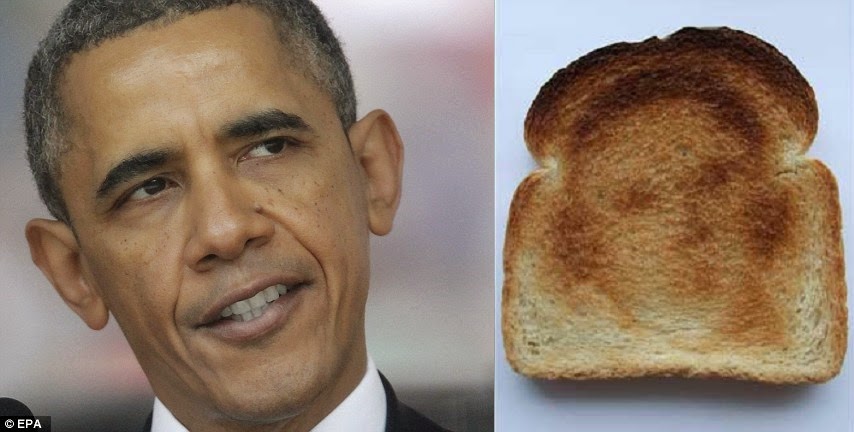
So Jesus himself, his mum and various mammals are traditional pareidoliac sightings but other cultural icons get their share of attention from our pattern insistent brains; Lenin on a shower curtain, Mickey Mouse on the surface of Mercury (what, not Pluto?),  Kate Middleton on a jellybean and, most recently, Barack Obama on that good old standby a slice of toast. 


Some instances of pareidolia are quite personal and specific. As a child I lived in my grandmother’s terrace house and at the spot where the top of the stair banister met the floor of the landing I  clearly saw  a grimacing face  in the cornice. As I was carried up in an adult’s arms I would come very close to this image, which I dubbed ‘the ceiling eye’,  and get frightened.  My father  plastered over the offending vision but like believers in demons everywhere I was convinced it still lurked unseen.


Not 'the Ceiling Eye' but with pareidolia near enough is good enough - always!

Pareidolia has its lighter side. My favourites are functional objects that have cute little faces a la Wall-e. They abound on the net. Here are a couple I really like:


Sometimes, as with Pooh’s clouds, a little artistic licence helps. Here are some I prepared earlier.


So, happy solo or collective hallucinations! Try to expand the popular repertoire. Elvis seems to be the only pop star to have manifested himself - in  a tree and a rock (google him). Where are the Britneys and Bonos? Mother Theresa  appears in a cinamon scroll (definitely google her), but there is no Mary McKillop lamington vision yet recorded. And why should Disney get all the publicity? How about Homer Simpson in your bathroom tiles or  the surface of the moon? Post your discoveries, you may start a cult!